UK rock fishing, for beginners, can feel highly intimidating. Scrambling over steep ledges and casting into deep water isn’t to be taken lightly – and unlike the ‘car park swim’ on your local lake, safety becomes of paramount importance. But the good news is that with a bit of upfront thought, and a few kit basics, getting started is far simpler than it looks. Rock fishing is, in fact, one of the most exciting ways to fish around the UK coastline. It’s a fine way to spend a few hours on a summer holiday, and it’s often how anglers first discover species like ballan wrasse, pollock and bass.
Why rock fish in the UK?
Fishing our rocky coastlines is a unique experience. Not only are they stunning; they’re often quiet, havens for wildlife, and are invariably difficult to access – fish are fond of them too, particularly wrasse and bass.
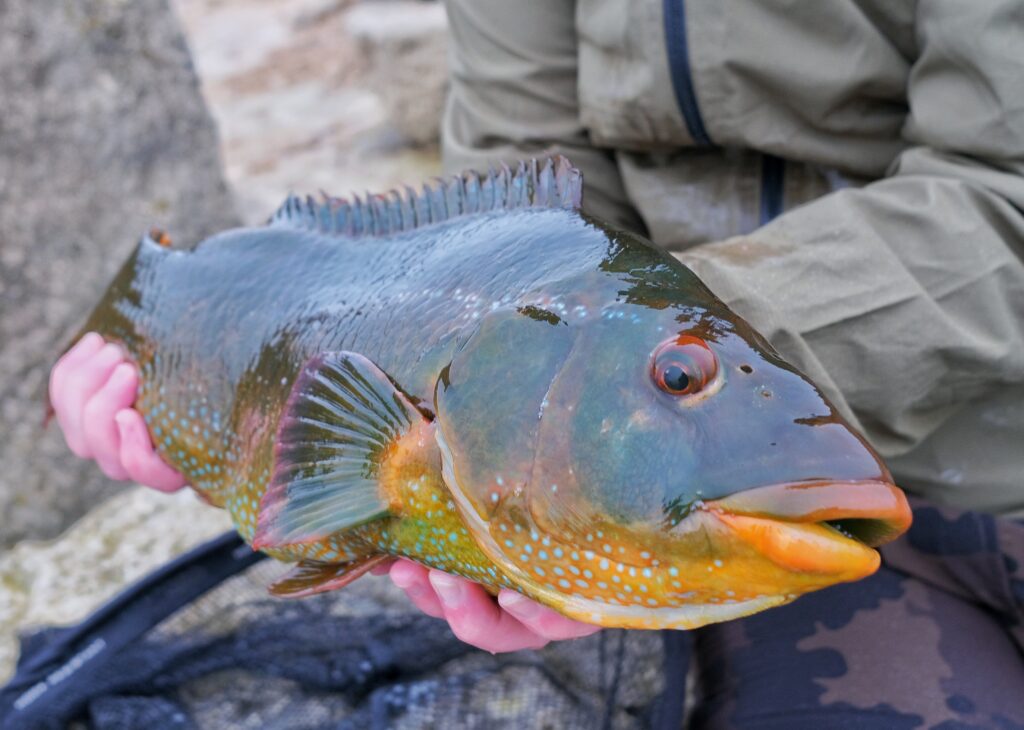
They’re natural holding zones for baitfish and offer larger fish plenty in the way of features and shelter. For rock fishing beginners, this can make the prospect of fishing, for example, a rocky cove with a few features, far more productive than blindly fishing an open beach.
Essential rock fishing gear:
You don’t need expensive kit to get started. A simple setup includes:
- One spinning rod of around 7–10ft – something in the 10g–30g range is optimal for lighter lure work (termed LRF or ‘HRF’)
- A second rod of 10–11ft in length, capable of casting a 2–3oz lead at short range – something up to around 90g, like the Daiwa Seahunter Z
- A fixed spool reel loaded with 15–30lb braid – I favour something tried and tested like Daiwa J-Braid
- Some hooklength material – strong fluorocarbon in 15–25lb, preferably (combined with the braided mainline, abrasion resistance is 100% the name of the game)
- Hooks, weights and swivels – decent Chinu hooks in size 1 or 1/0 from Cox & Rawle or Mustad, and strong snap swivels from the likes of Tronix Pro
- A landing net or drop net for tricky marks – the Daiwa 5.9m net seems to be the gold standard for ‘lerfers’ everywhere
- Kit-wise, you’ll also want decent walking boots, a sturdy rucksack, a sun hat and some waterproofs

Regardless of whether you plan on rock fishing for wrasse with lures or bait, it is important not to undergun your tackle in the name of finesse. They’re strong fish that live in unforgiving environments. In the modern age of quality tackle, I don’t think we should be fishing unnecessarily light with this style of fishing; it’s not good for the environment, the fish, or our wallets.
Staying safe on the rocks
Safety is one of the most important parts of UK rock fishing for beginners. Always:
- Check tide times before fishing, and know the moon phase
- Know the maximum height of the tide – will you be safe where you are, and how will the tide and swell behave?
- Wear boots with reliable grip and ankle support – no one wants to roll an ankle in the arse end of nowhere
- Consider wearing a life-jacket and/or a high-vis
- Let a family member or friend know where you’re fishing and when you’ll be home, or due to check in
Starting with easy-access marks is, of course, the best approach until you feel more confident – and fishing with a friend is always sensible and advised.
Species you can catch
One of the best things about rock fishing is the variety of fish available:
- Ballan wrasse
- Corkwing wrasse
- Pollock
- Bass and garfish
- Plenty of mini species, such as scorpionfish and gobies
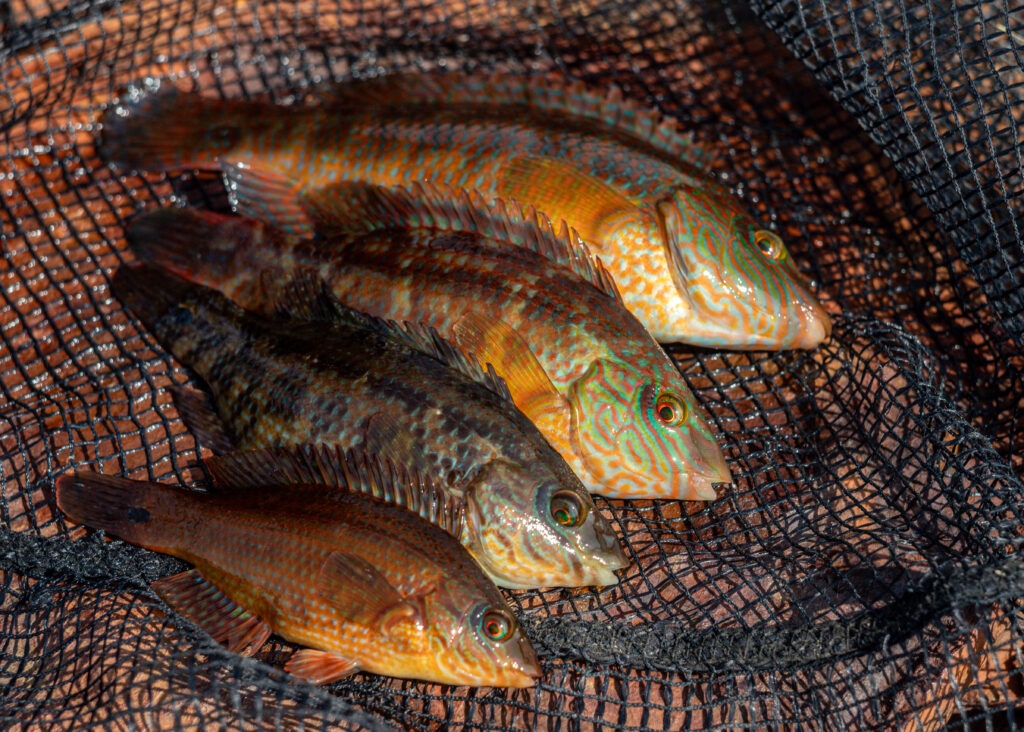
They’re all reasonably abundant (if you can find their hidey holes) and not particularly shy biting. If I had to pick one approach for a rock fishing beginner, it would be simple scratching rigs fished with light leads and ragworm, on a calm summer’s day. You’ll pick up plenty of corkwing and ballan, have a reasonable chance at mini-species, and get a feel for how the tide behaves on the type of ground you’re fishing over.
Lure fishing is a whole other kettle of fish, but equally effective – and these days, hugely popular! Fishing soft plastics on Texas and Carolina rigs, or ‘Chebs’ is all the rage, with paddletails, creature baits, senkos and even metals all producing plenty of quality wrasse each year. For light lure gear, The Big Lerf Tackle Shop is always my favourite place to start!