UK Ballan Wrasse Fishing
In my very biased opinion, shore fishing for ballan wrasse is some of the most exciting fishing that the UK south coast has to offer. Simply put, wrasse fishing is raw, rugged, and highly addictive. Wrasse are incredible fish and they live in incredible places, and fishing for them is surprisingly easy, once you know how.
Those who know me will know I am not much of a “how to” sort of chap, but this post is – definitively – my own take on how to catch ballan wrasse. This guide covers how to catch wrasse, where to find them, and (in my opinion) the most effective bait and lure fishing tactics to catch them from rough ground.
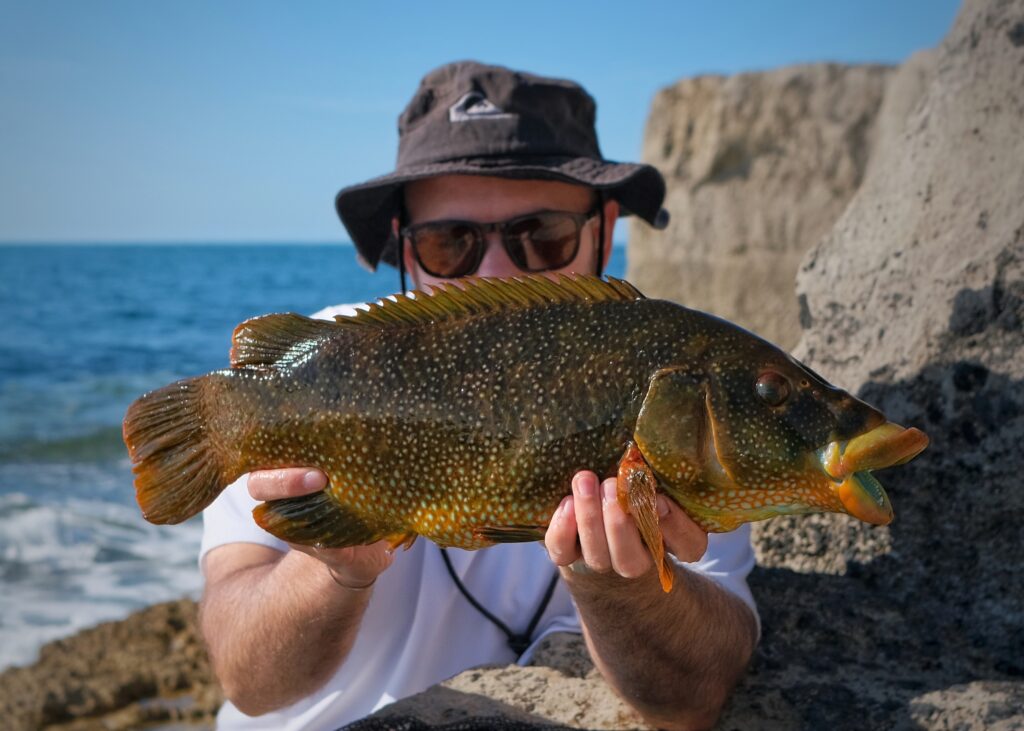
What Are Ballan Wrasse
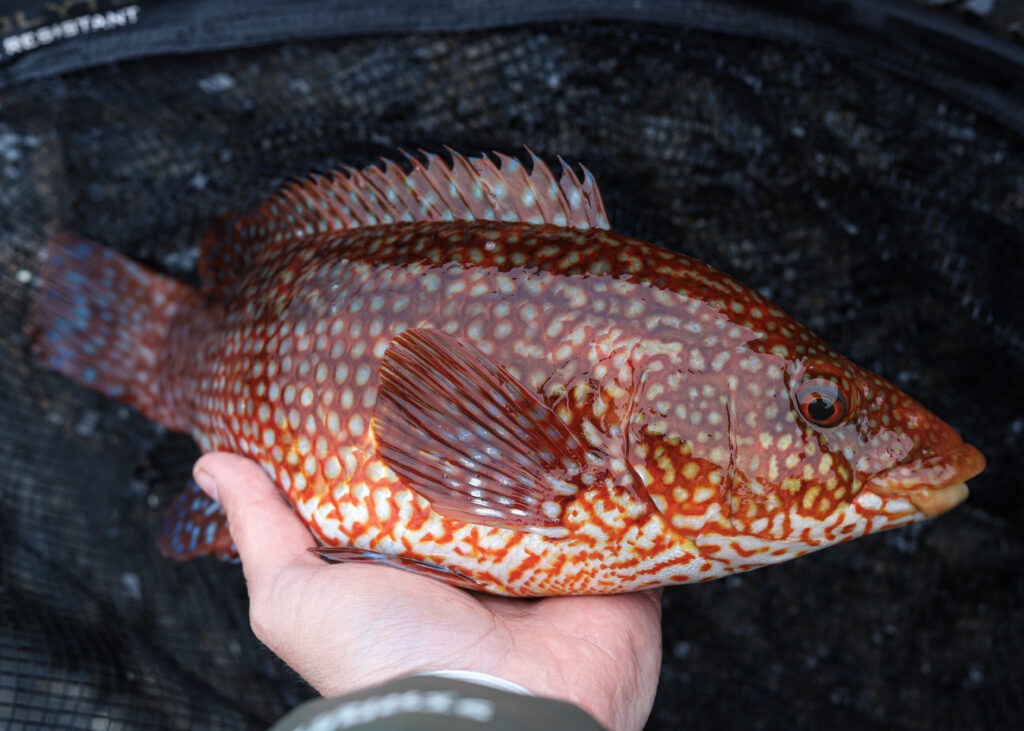
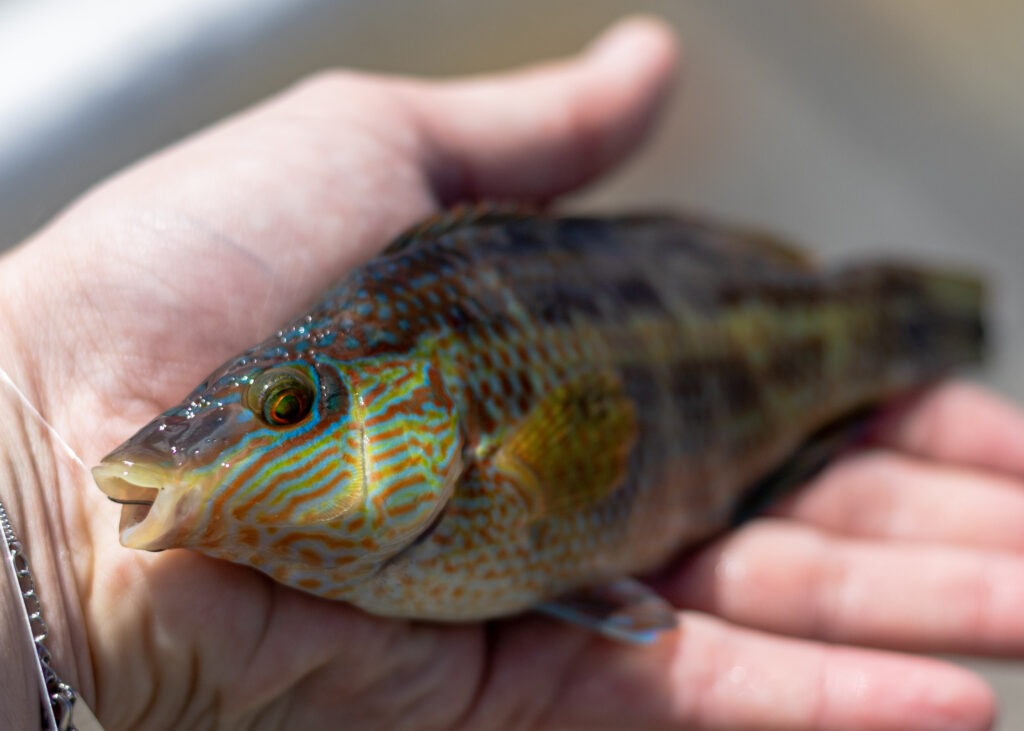
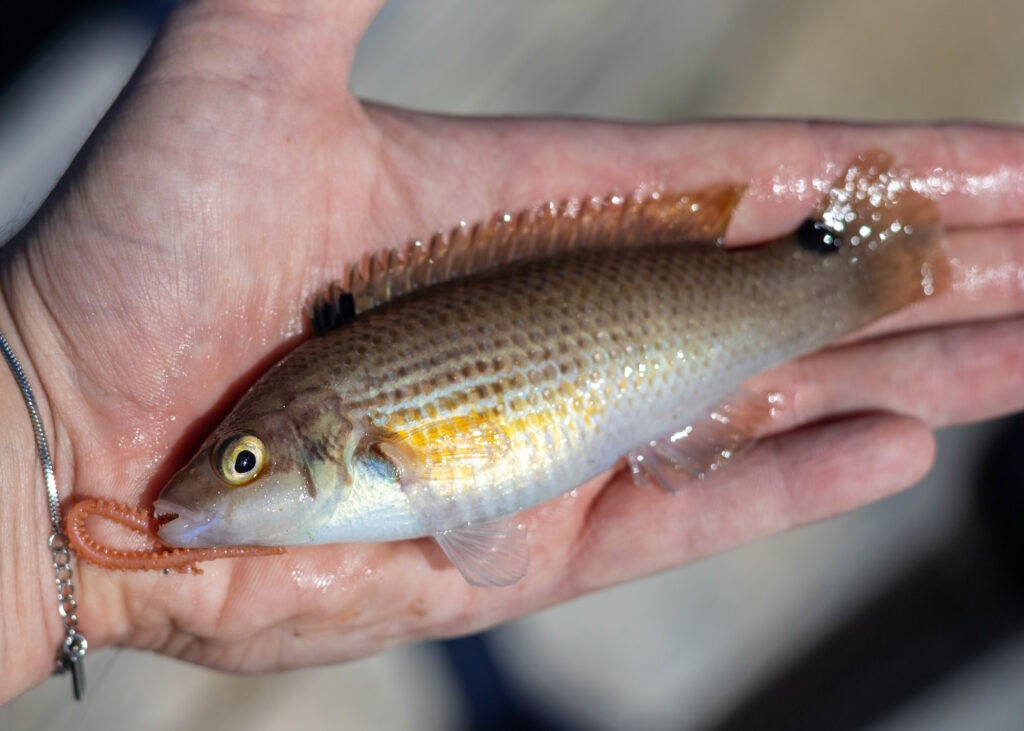
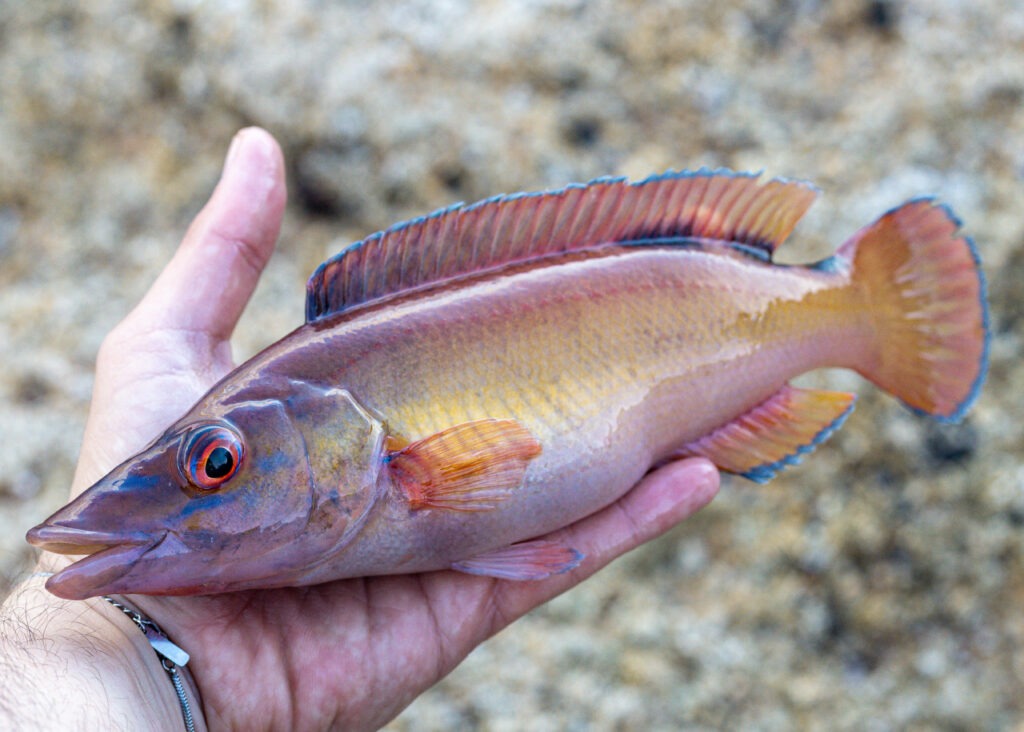
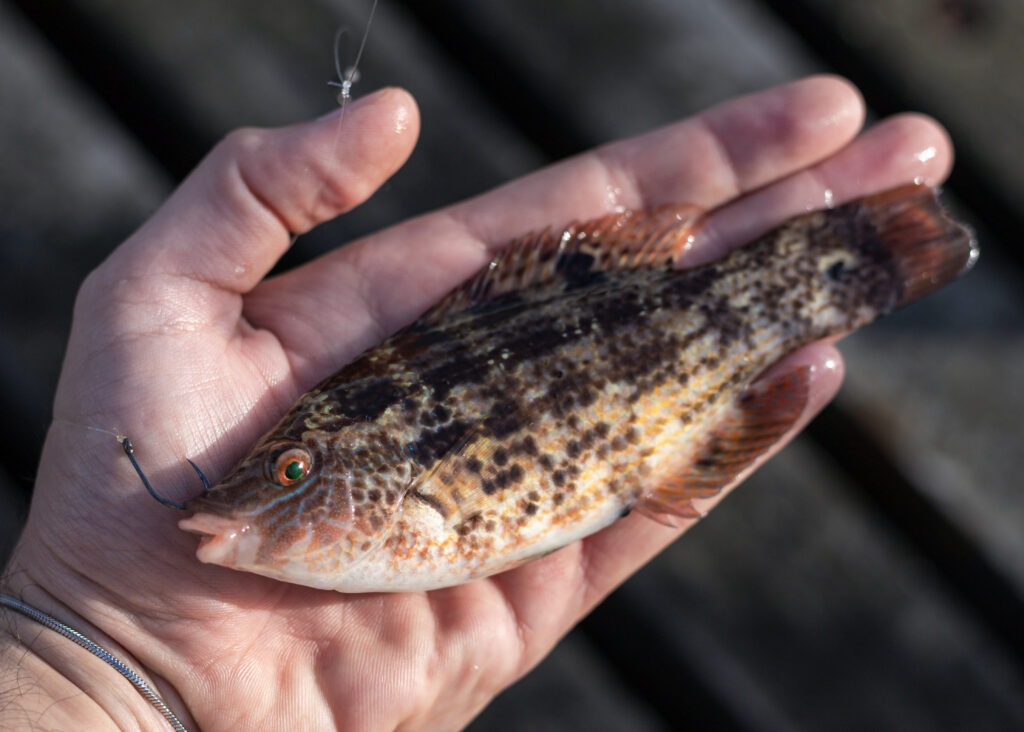
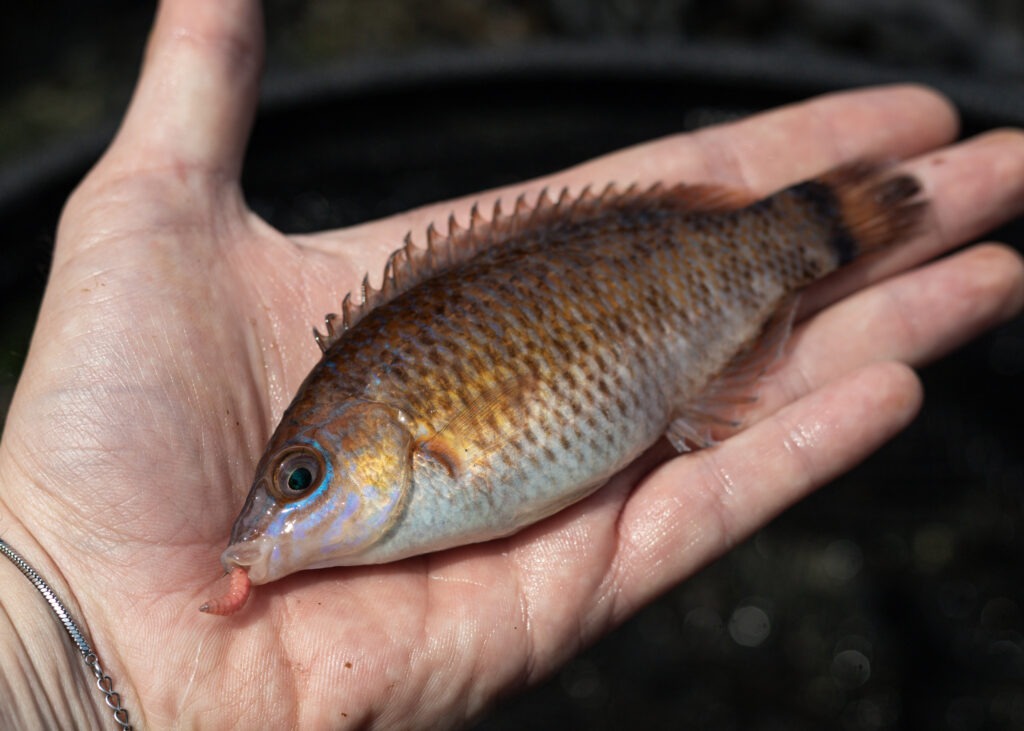
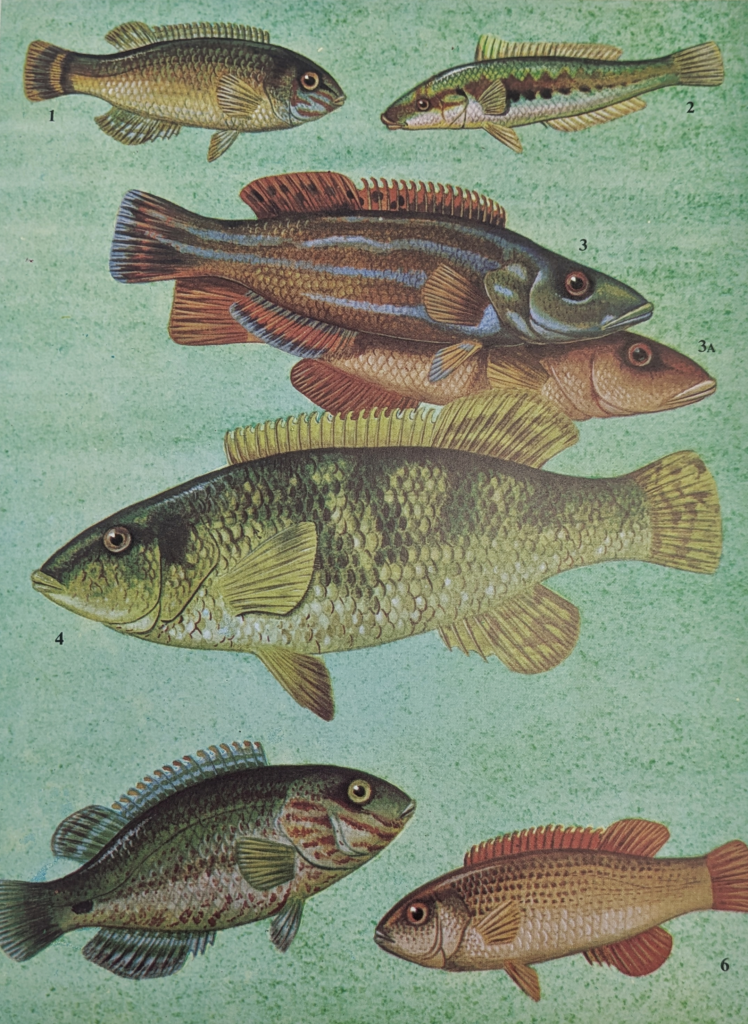
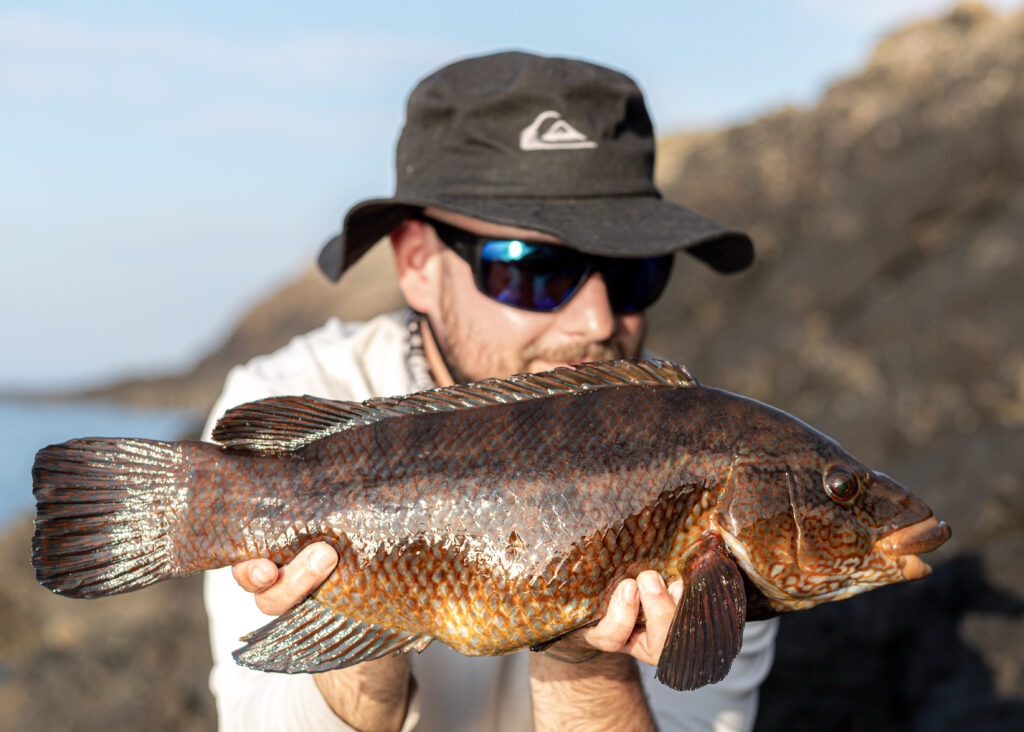
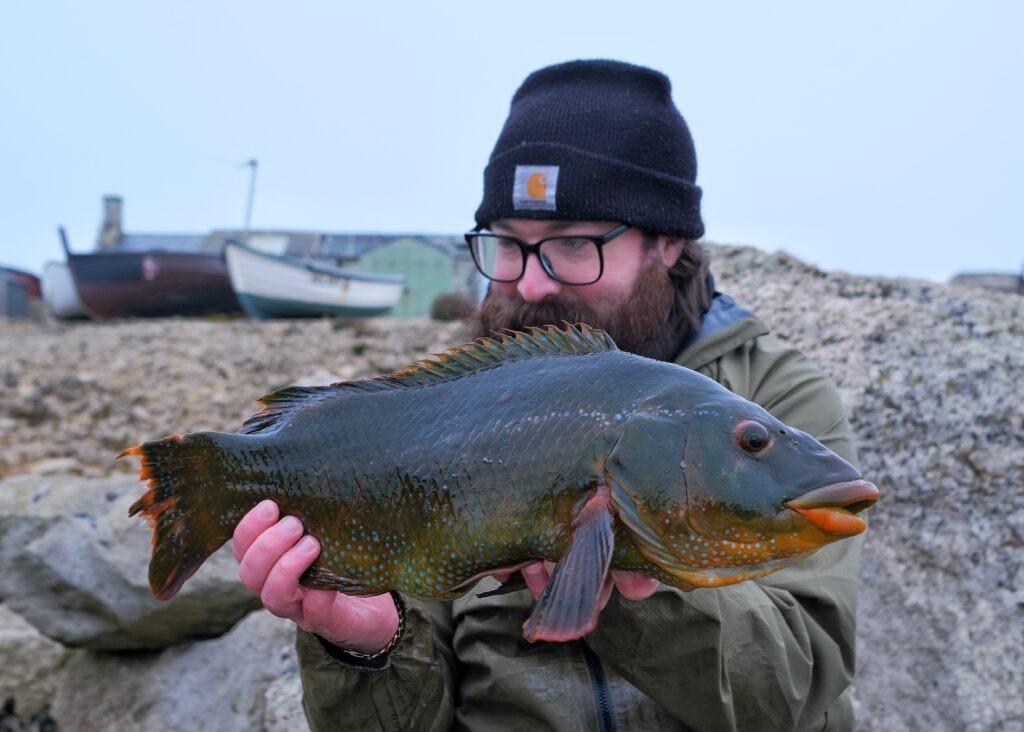
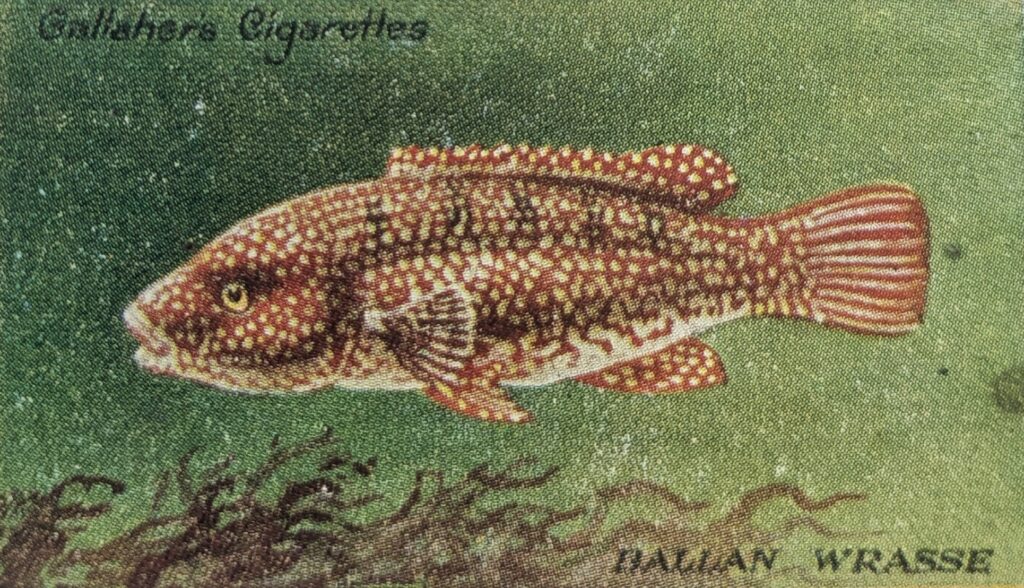
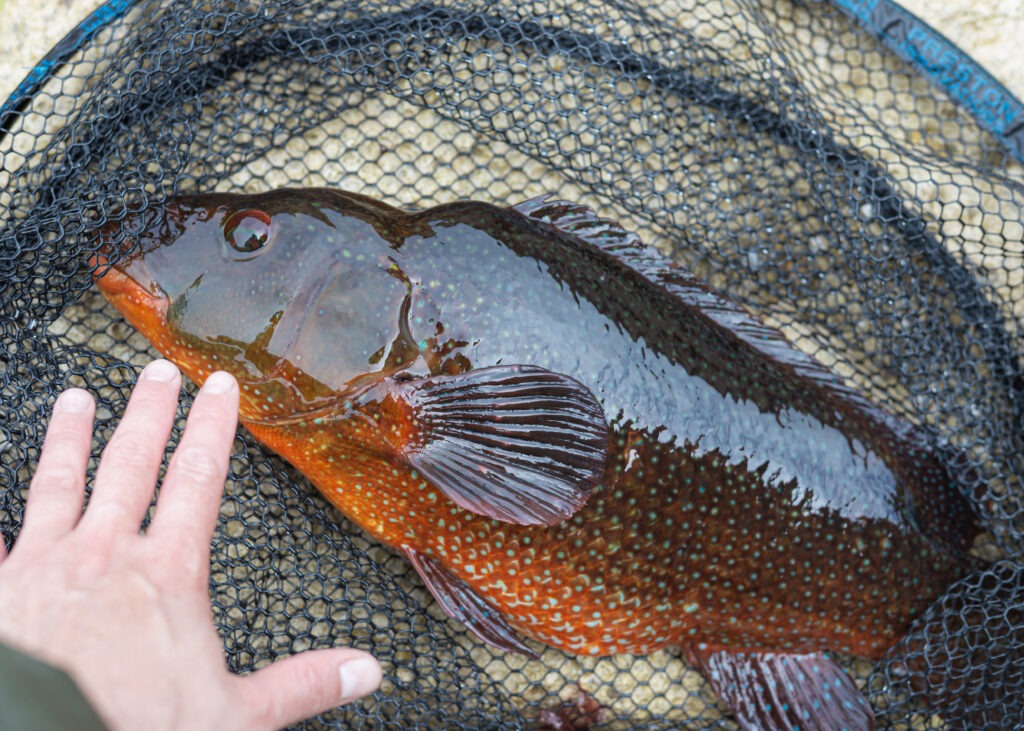
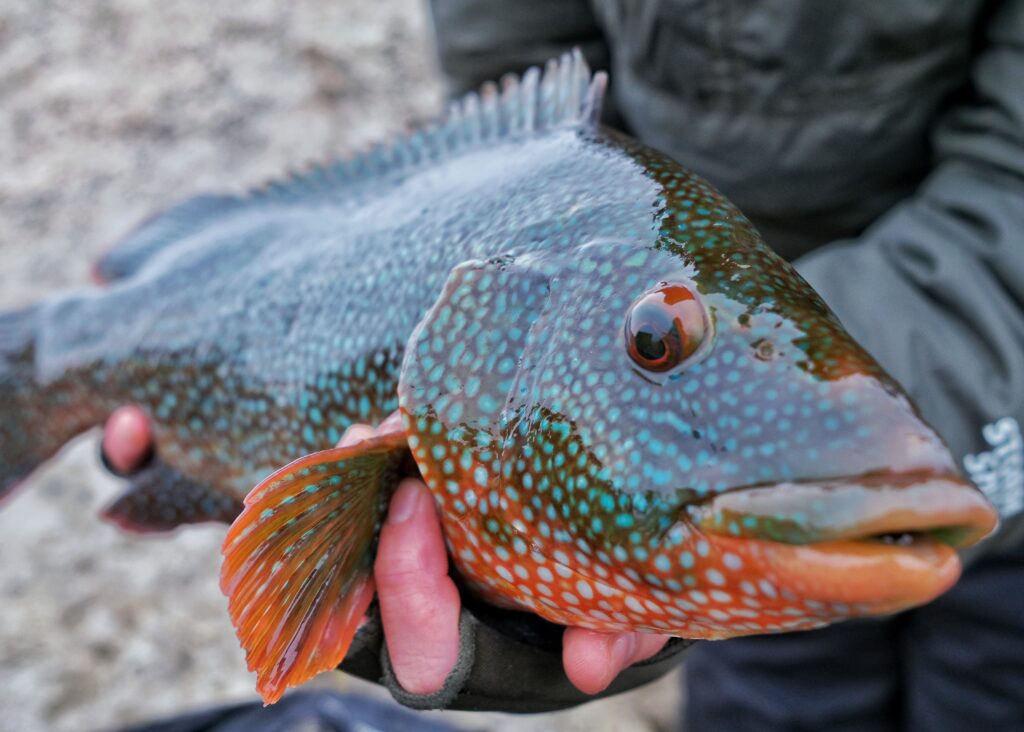
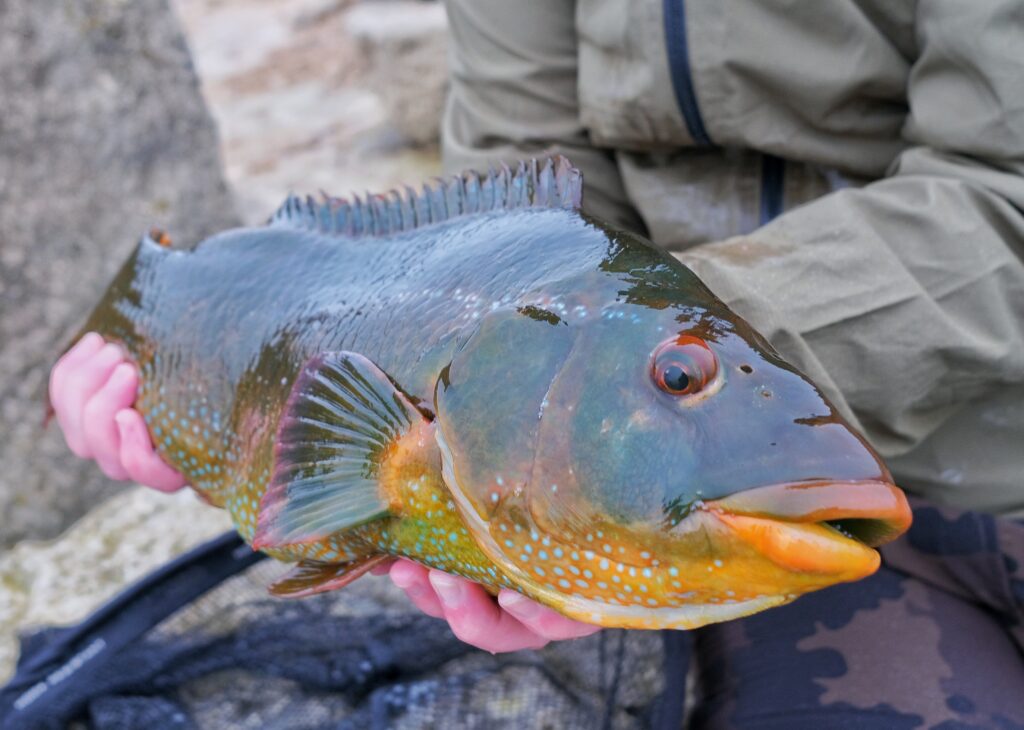
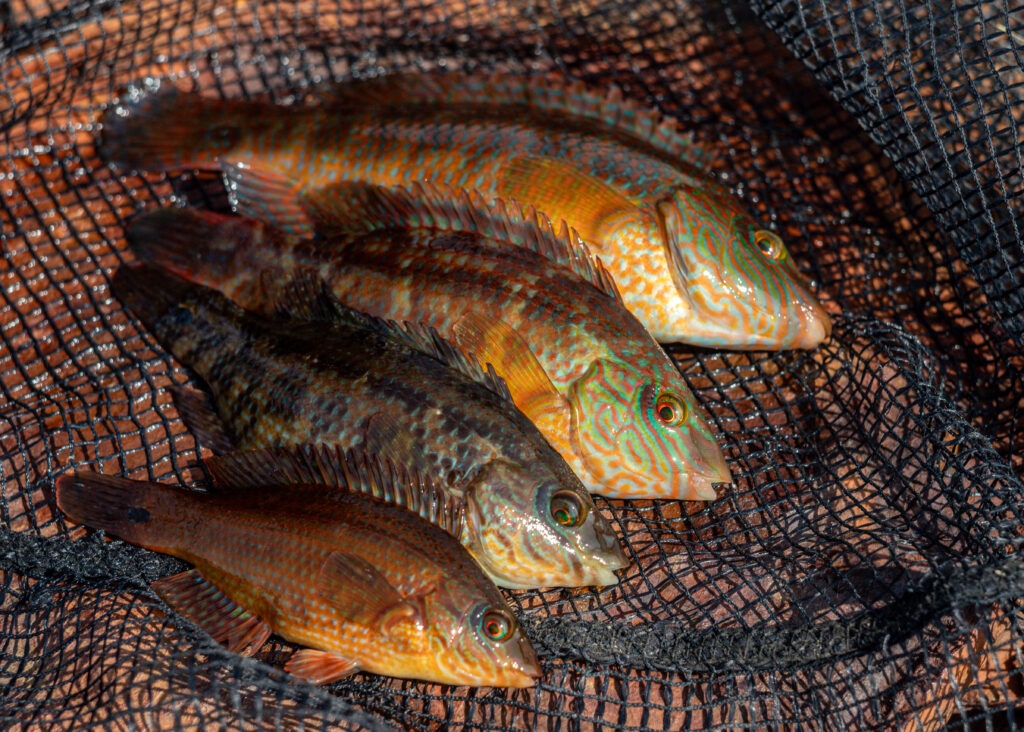
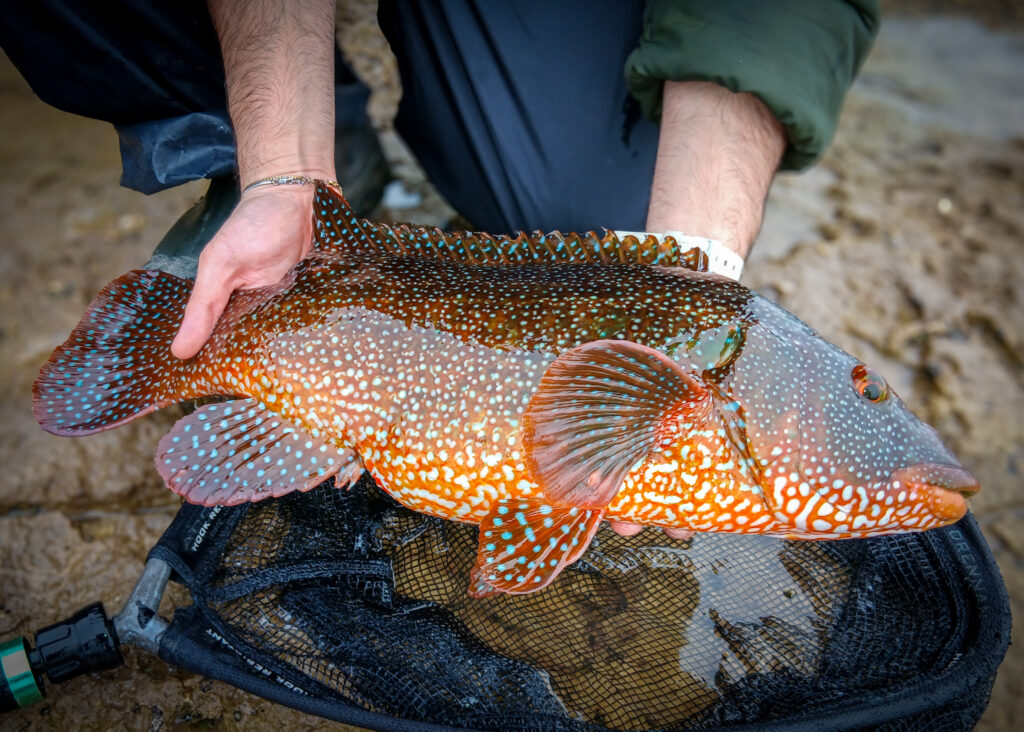
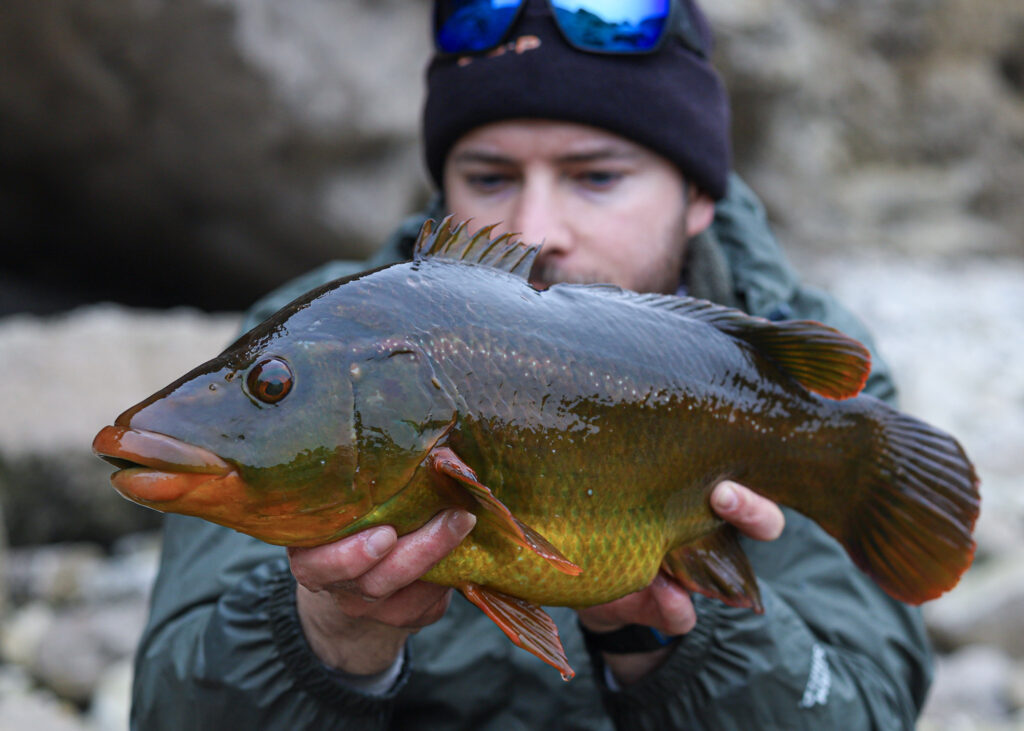
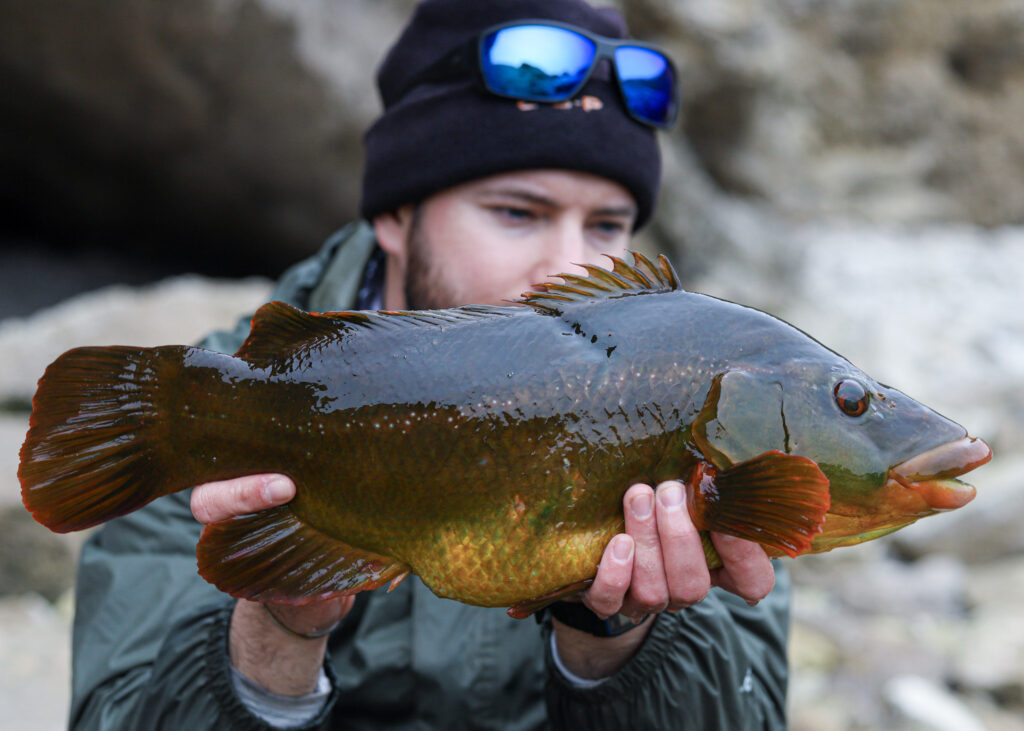
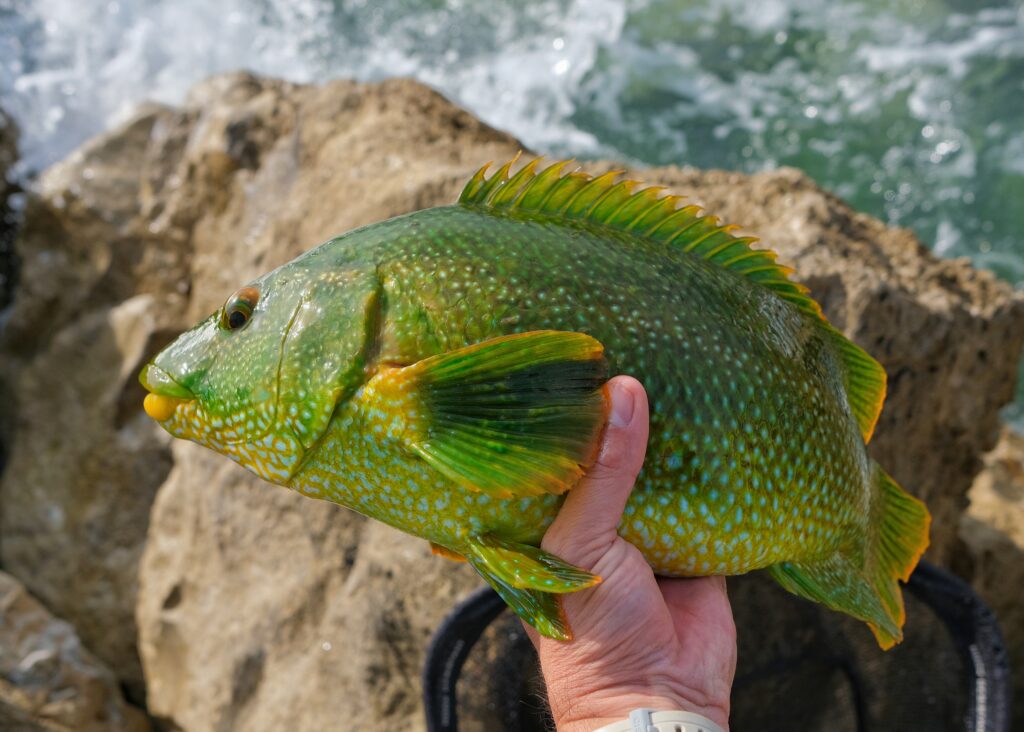
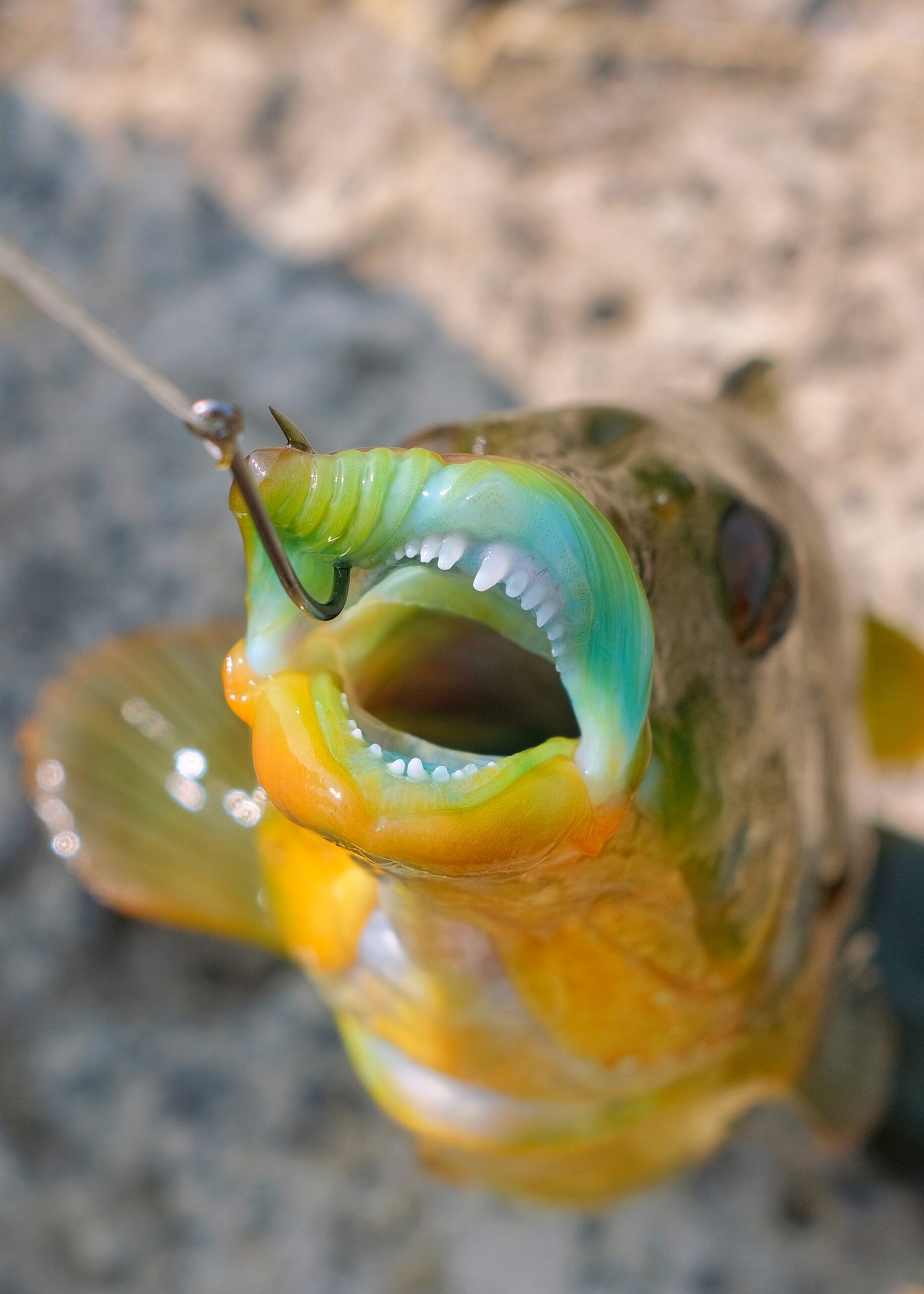
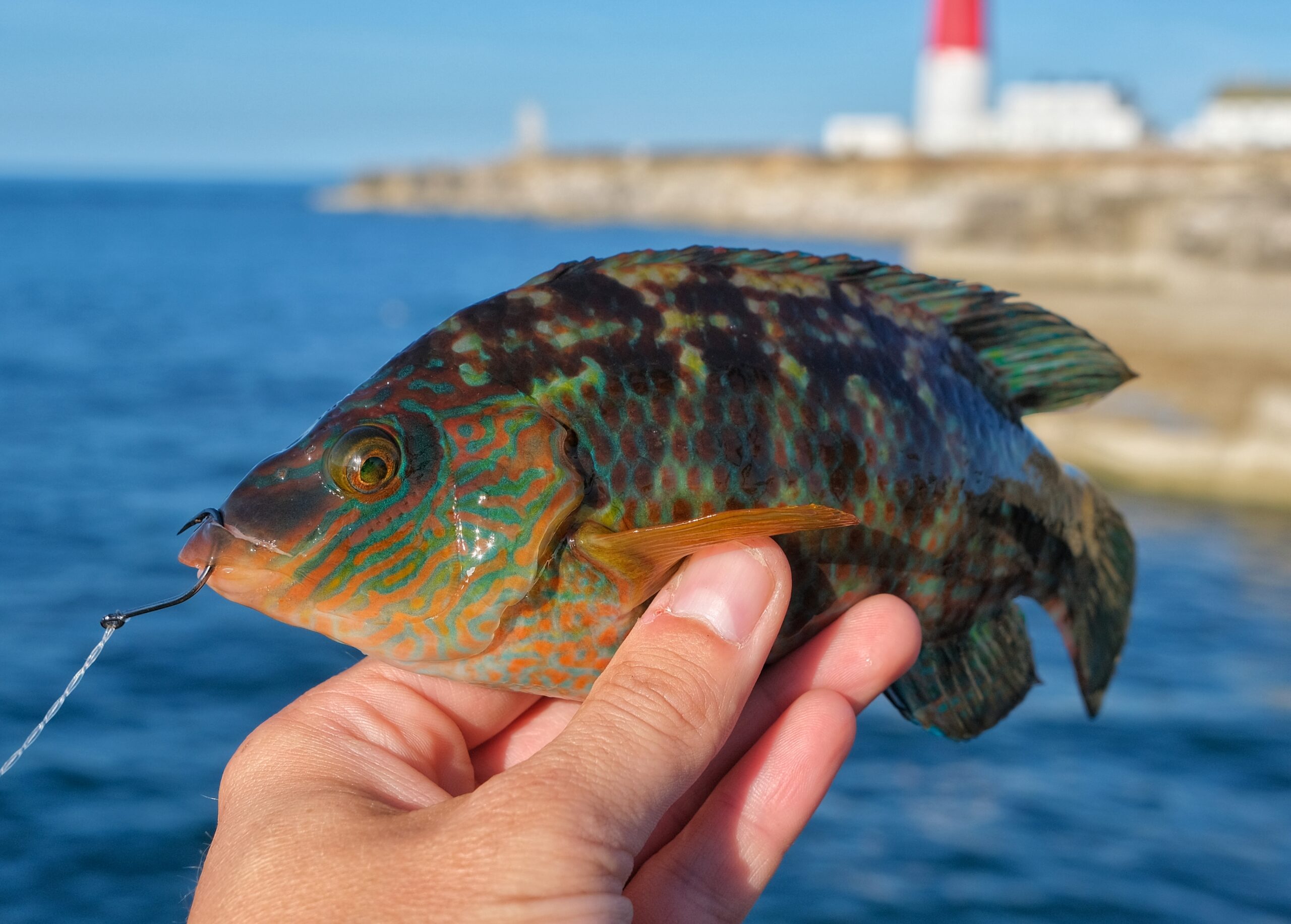
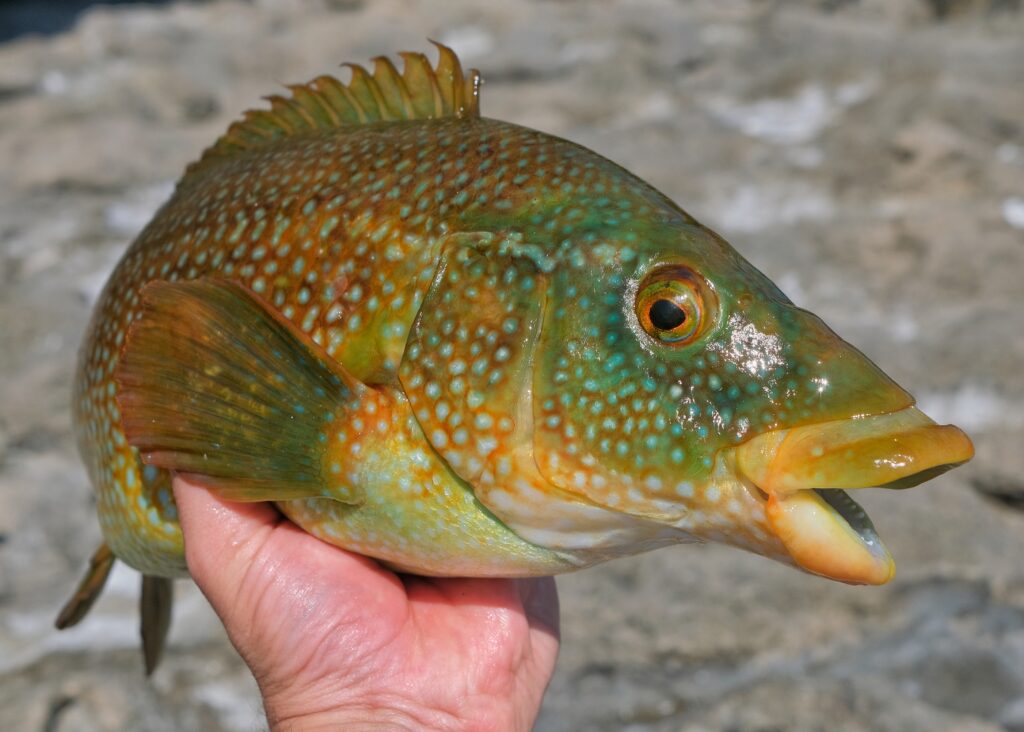
Ballan wrasse (Labrus bergylta) are the largest wrasse species found in UK waters, and – for their size – they’re one of the hardest fighting fish you can target from the shore. They are a thick-set and powerfully built fish which is designed for the demanding reality of a life spent living in the rough stuff; likewise their broad heads and crushing teeth are designed for feeding on shellfish, crabs and small fish. Once hooked, if hooked, they’ll make a dive straight back into the rockwork and have you hanging on for dear life!
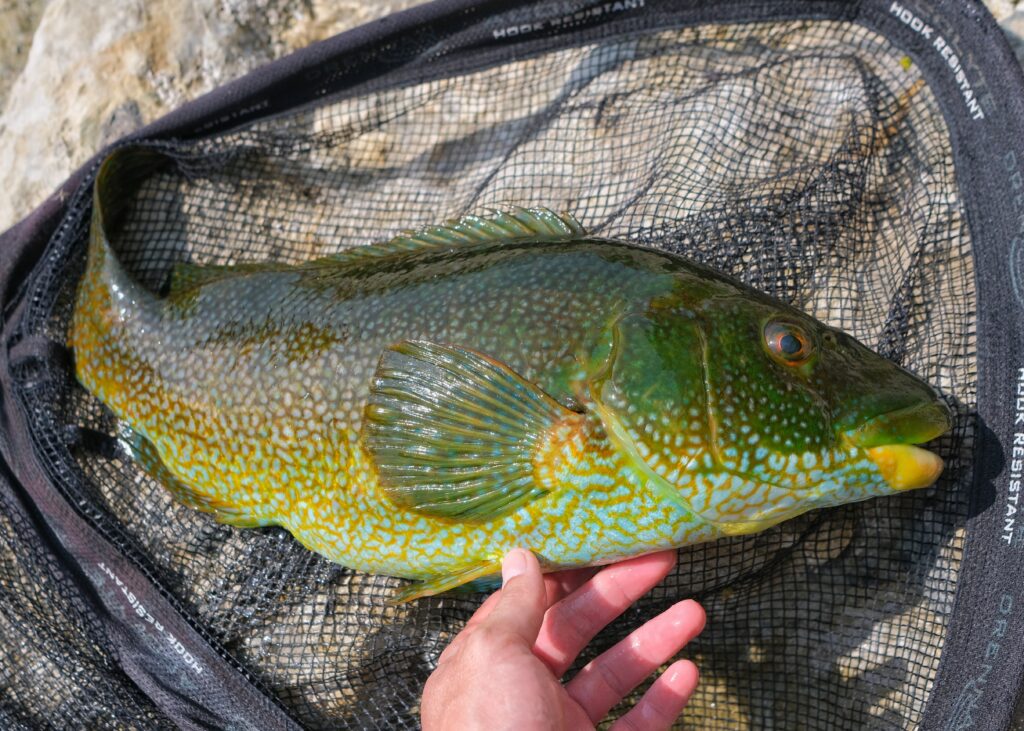
They are also long-lived and particularly slow growing. Interestingly, they’re hermaphrodites, too, with all fish starting out female and taking five or six years to reach sexual maturity, before potentially becoming males. A really big ballan wrasse – a male of 4lb plus (1.8kg) – can be twenty or more years old, which is why diligent fish care is essential in wrasse fishing.
Where Do Ballan Wrasse Live in the UK
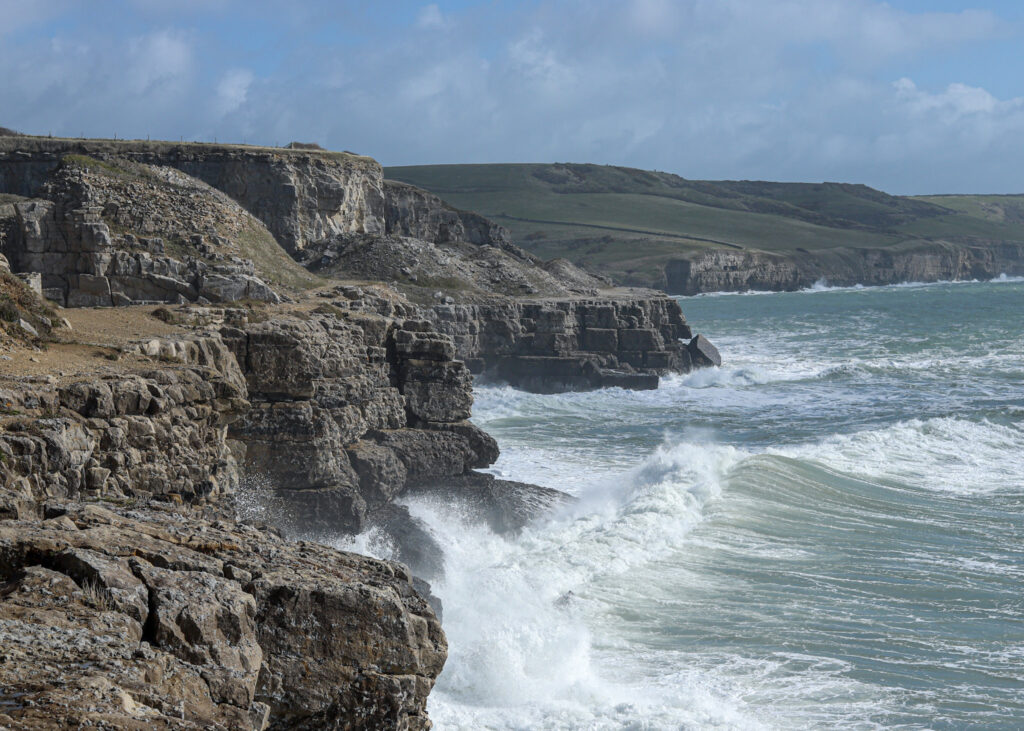
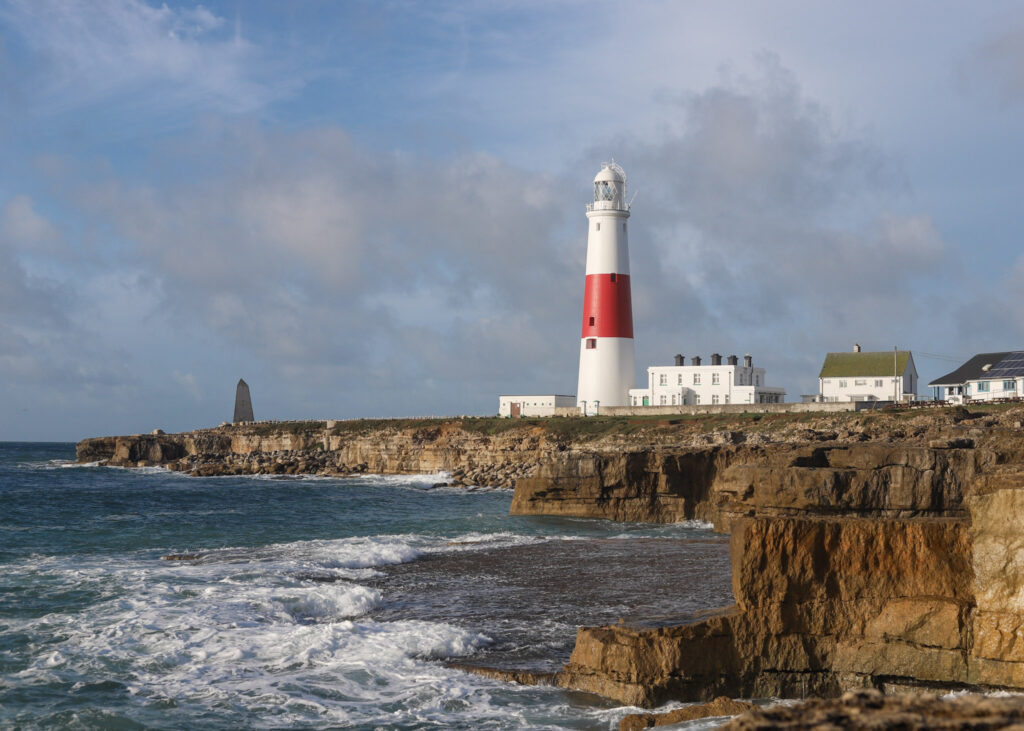
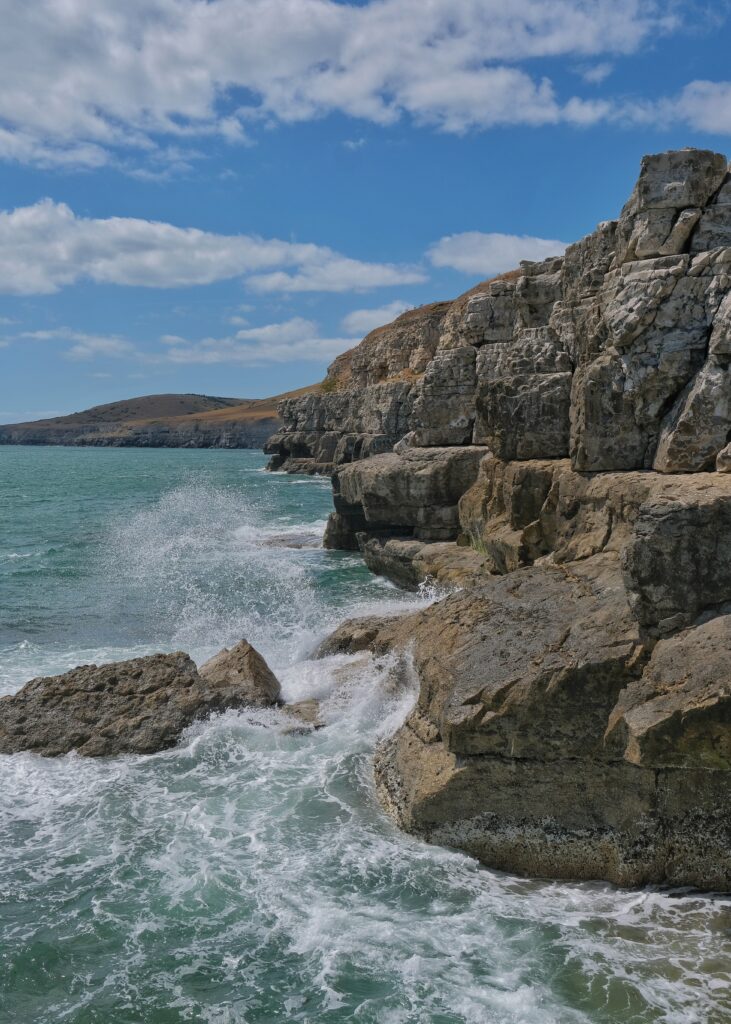
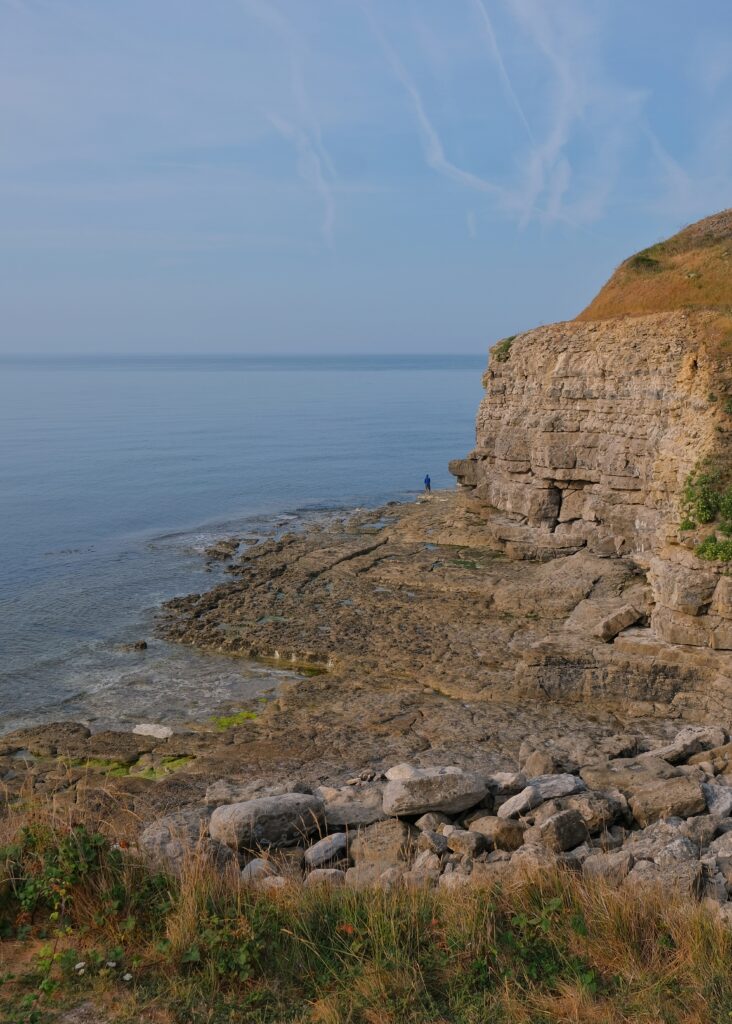
Plain as day, ballan wrasse are a rough ground species in the UK. They adore the rocky parts of our coast around Dorset, Devon, Cornwall, Pembrokeshire and Scotland.
You’ll typically find them around marks which have:
- Big old kelp beds
- Weed-festooned rocky ledges
- Hideously sized boulders and broken ground
- Gullies, and the numerous cracks and crevices within
Anywhere that offers both cover and food is worth targeting – so if there’s structure, there’s a good chance wrasse will be present. They are rarely found over clean, featureless ground – though I’ve also seen surprisingly big wrasse hiding in eelgrass beds, when snorkelling. However, generally, the rougher and snaggier an area looks (and feels!) the better it will likely be for wrassing.
Where to Target Them
As above, when beginning to learn how to catch ballan wrasse, location is everything.
Focus on:
- Gullies that flood well on the tide
- Weed-covered ground that runs up against hard structure and cliffs
- The bases of ledges or bommies (i.e. reefy boulder clumps)
- Tight cracks and holes between bigger boulders
A common mistake is casting too far, as many of the best wrasse can be taken either close in, or an under-arm flick away. I’ll rarely over-arm cast a bait, for example, and would only do so when I’ve exhausted all other options close by.
The Importance of a Good Gully
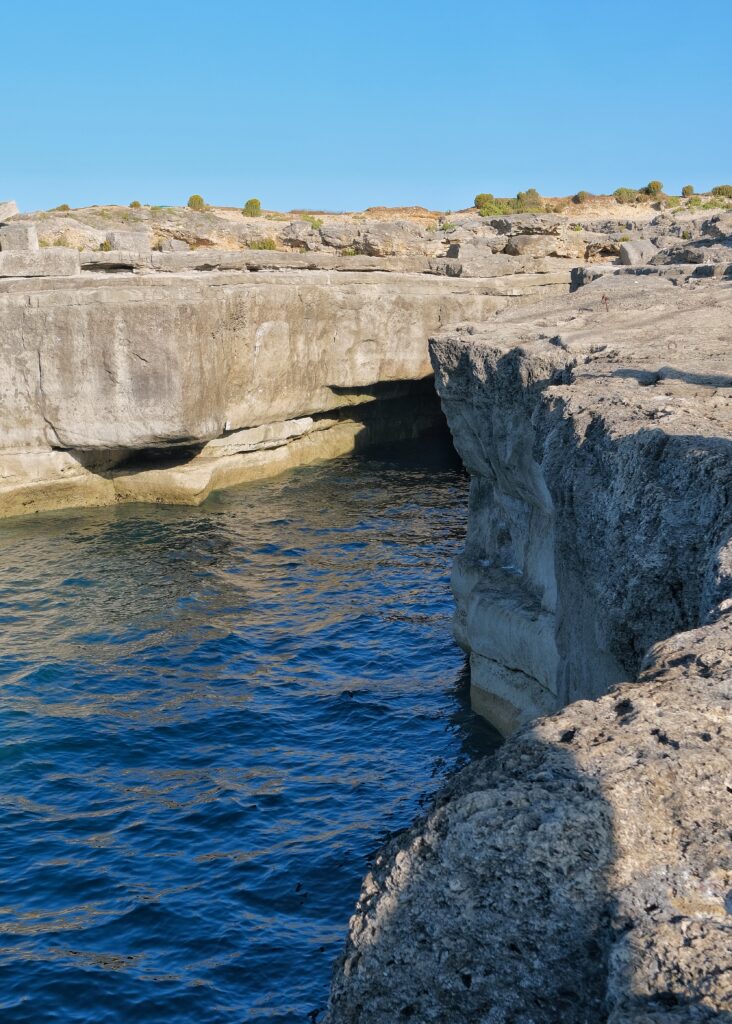
Alongside the obvious structure that can be both seen and felt beneath the surface, one other feature worth hunting out when wrasse fishing in the UK, is gullies.
Gullies don’t have to be big, or deep – though even a gully of a metre or two across can have some surprising depth. Whilst they aren’t productive at all stages of the tide (I think around high to be best, or two hours before/after high) they are such effective places for wrasse fishing because they tick so many of the boxes described above.
- They provide unparalleled shelter from wind, waves, and swell
- They’re naturally rocky and full of cracks and crevices
- They’ll provide protection from bigger predators like hungry seals
- They’re a natural feeding zone and often abundant in prawns, gobies etc
Because of this, even shallow gullies shouldn’t be ignored. Wrasse will have a jolly good feed in them as the tide pushes in, which can lead to some really hard takes. They’re there to eat, after all! Having also done a bit of snorkelling around gullies, I’ve noticed that the wrasse that will sit in them won’t pin themselves to the bottom the same way they would in more ‘open’ water, either; they’ll move higher in the water, pecking at invertebrates on the rocky walls as they do so. A bait or lure, therefore, doesn’t always have to be presented hard on the bottom. Varying your presentation, and bouncing a lure/bait up the side of a gully wall can therefore be very effective.
Understanding the Moon + The Tide
Where to start with moon phases…
Each month, you’ve a new moon and a full moon: these are the biggest tides. Between them you’ve got half-moons, which have the smallest tides i.e. the smallest difference between high and low water. The new/full moon tides are known as spring tides, and the half moon tides are neaps.
Wrasse can be caught on any tide, but my personal preference (for actually catching them) is somewhere right in the middle of a spring and a neap. So, about a quarter moon. My reason being that a spring tide can often be too forceful and make presentation problematic when the tide is really running – and a neap tide is often just too static. A bit like bass, wrasse do definitely respond to a bit of ‘energy’ and/or colour in the water. If it’s too quiet they go all lethargic, and if it’s too rough they’ll hunker down.
Likewise, there’s no universal ‘best tide’ for ballan wrasse fishing – it all very much depends on the mark and how/when you’re going to fish it. In general, I prefer a flooding high-tide, and a few hours around it, but that reflects the fact I can generally access my regular marks at any stage of the tide. Low water isn’t essential for access, in my case.
- Some spots do appear to fish best on low water, particularly if you’re casting a little further out
- But other spots, like flat shelves, clearly need a bit of depth on top of them to enable fishing and confidently feeding fish
- The tide can also affect water clarity; e.g. an ebbing high can pull colour into the water, which can turn the fish on/off
If fishing a new area:
- Start on a low-tide to better read the ground – fish your way up to high
- On the low, identify the gullies, weedy areas and structure
- Make a mental note of when the fish begin to move in, and bite – this will generally be obvious, consistent, and it can feel like someone has literally ‘flicked a switch’
But of course, do also always keep track of the tide and the swell when rock-fishing – don’t let yourself get cut-off or caught out by an unexpected swell. See the ‘Safety’ section, below.
Seasonal Behaviour
Wrasse can be caught year-round. However, when you can actually safely get out and fish for them is very much dictated by the weather! Thus, you’re more likely to actually get out on the rocks in the relative safety of late spring and summer.
Spring itself can be highly variable, owing to changing weather and water temperatures. Whilst early spring can often be quiet, mid-spring can be red-hot as fish fatten up for spawning. Water clarity is often also better, and improving. I find that later on in the spring (think late May/June time) can often feel really great for fishing, but actually be really uneventful – as when the water temperatures consistently hit a certain level the fish will be more interested in spawning than feeding.
Through the later summer months the fish are certainly more aggressive, and more willing to chase a lure – I find the better fishing really switches on around August, but ‘bite times’ can be narrower in e.g. hot/bright weather, with morning’s best. In the winter, fish and bites are often slower; they’re more cautious but deliberate, and can come throughout the day seemingly without rhyme or reason. Whilst the quantity of takes slows right down in the winter, the average size of the fish is markedly better. A bit like when fishing for e.g. perch and pike in fresh water, winter fishing is slower, more methodical, and involves keeping your bait or lure in the ‘hot spot’ for longer.
Safety on the Rocks
More so than sitting by your local club lake, or a sandy strip of shore, rock fishing inherently carries risk, particularly in exposed or remote areas.
- Watch the swell, the sets of waves, and know the tides
- Know how the wind has been, and/or whether it’s due to turn
- Wear proper footwear – good boots, with e.g. studs for grip
- Bring a thick suncream, a floppy hat and some polaroids on bright days
Safe fishing should always come before catching fish. As an extra-precaution, consider wearing a high-vis, or even a life-jacket. Likewise, always carry a first aid kit, and water, and be sure to let a loved one know where you’ll be fishing, and when they can next hear from you.
Fish Care + Responsibility
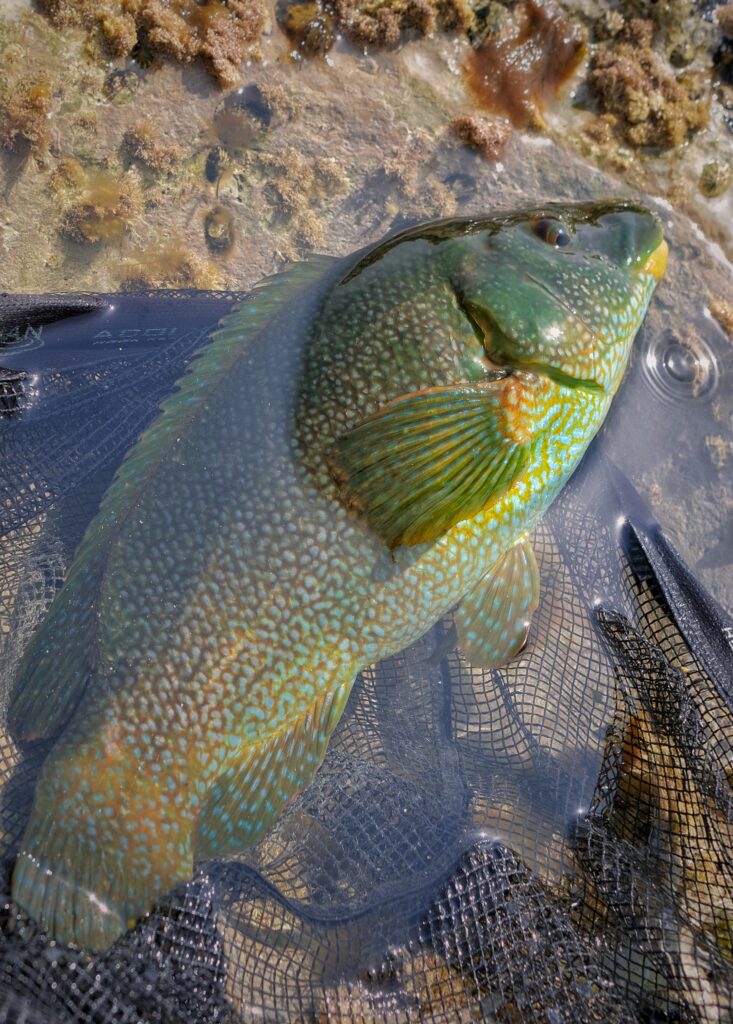
Good fish care is essential for big ballan wrasse, as they’re slow growing, long-lived and ecologically important… Whilst they are clearly mean machines when they’re in the water, they are very sensitive to damage, deep-hooking and rough handling.
By way of best practice:
- Use a long landing net or a drop net to bring them in
- Avoid lifting and/or winching fish from height
- Consider keeping a folding water bucket with you to rest fish, when there are no rockpools nearby
- Make sure to have a pair of forceps for easier unhooking
- Minimise their time out of water, and release them slowly
- Handle them carefully, watching out for their spines on the dorsal and anal fin!
A really big male may be decades old, so proper care ensures the future of the fishery – which is essential, if we are to truly “Make Wrassing Great Again”.
Bait Fishing for Ballan Wrasse
Casting out
You’ve done it. You’ve spent ages walking – you’re sweating your arse off and you’ve just slung your backpack down on the rocks with an audible groan. Your bucket of bait is full to the brim – still nicely chilled – and you haven’t lost anything along the way… Success! You’re now standing on the rocks, eyeballing the water, and it’s time to cast.
The good news is that when bait fishing for UK ballan wrasse, you’re not looking to punch a bait out to the horizon… Far from it, actually, and as you’d expect (having read the above) your main targets are the rocks, weed beds and gullies at your feet – certainly within an under-arm cast, anyway.
The important thing when casting a bait (and/or lure) – especially one intended to be tight to structure – is to let the bait fall through the water column on a slack to semi-slack line, to avoid it pendulum swinging towards you and away from the structure. When I feel the bait (i.e. the weight) hit the deck, I like to give it a subtle bounce just to make sure the weight isn’t stuck. When you’re happy, tighten up by reeling down towards the bait and maintain a taut (but not tight) line. At this point you could put the rod on a tripod, but I prefer to touch-ledger so I can keep close contact with the bait.
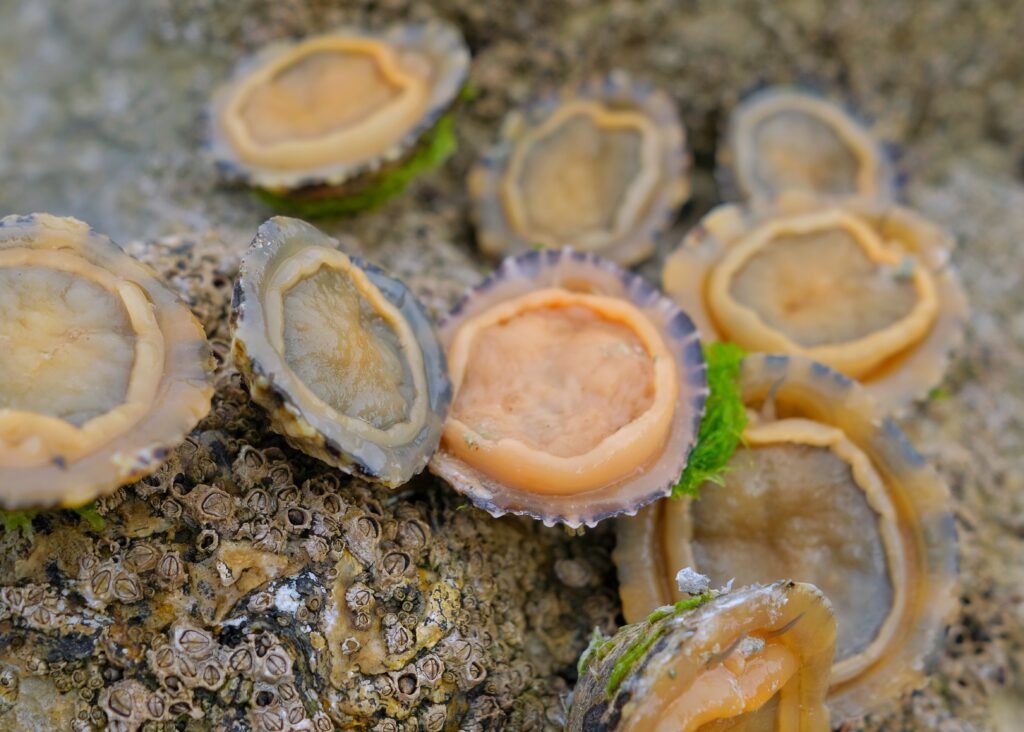
Types of Bait
Ragworm
… Is a great all-round bait for UK ballan wrasse fishing. The ‘maggot of the sea-fishing world’ ragworm is adored by sea fish, especially wrasse.
- Fish it whole or in sections
- Thread it onto the hook, round the bend, and well up the shank
- Leave a little bit of excess worm hanging off the hook at your peril; it’ll attract bites, but also get hen-pecked by smaller fish and you won’t hook up!
Prawn
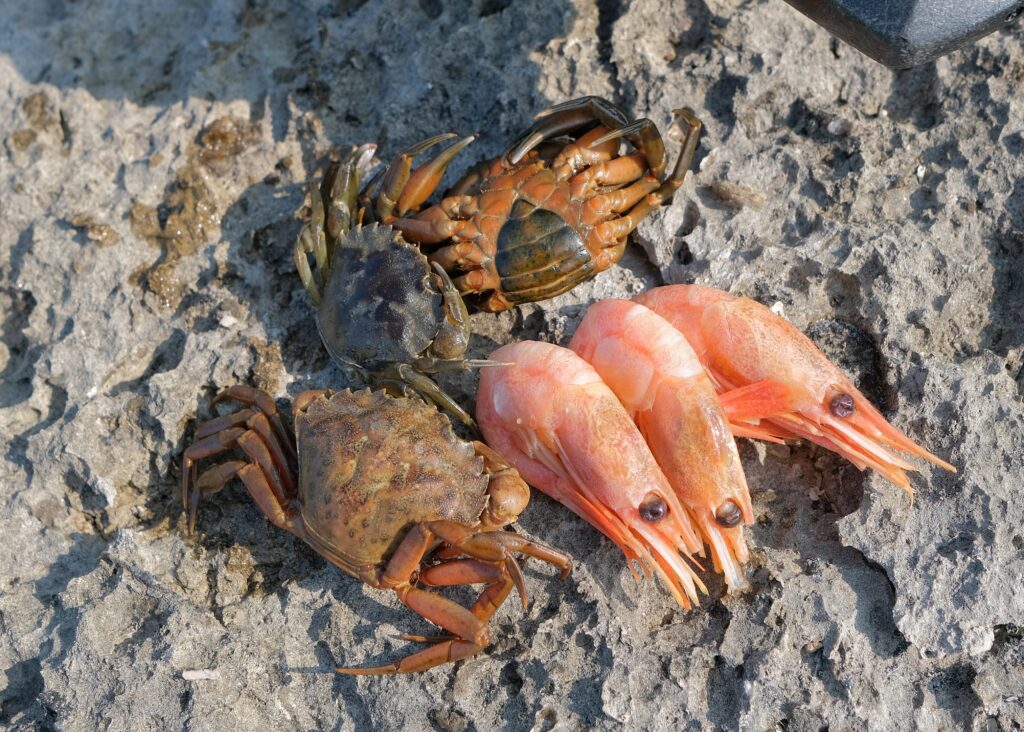
… Is an ever reliable and slightly more durable bait than ragworm. Fished dead or alive, cooked or raw, shelled or unshelled – it picks up plenty of fish when fished in the rough.
- Hook it securely, starting behind the head and threading the body along the bend of the hook
- A chunk of prawn on a smaller hook is an excellent way of picking up smaller wrasse and finding out ‘if anyone’s home’
Crab
… Is, in my view, the best bait for consistently targeting bigger fish.
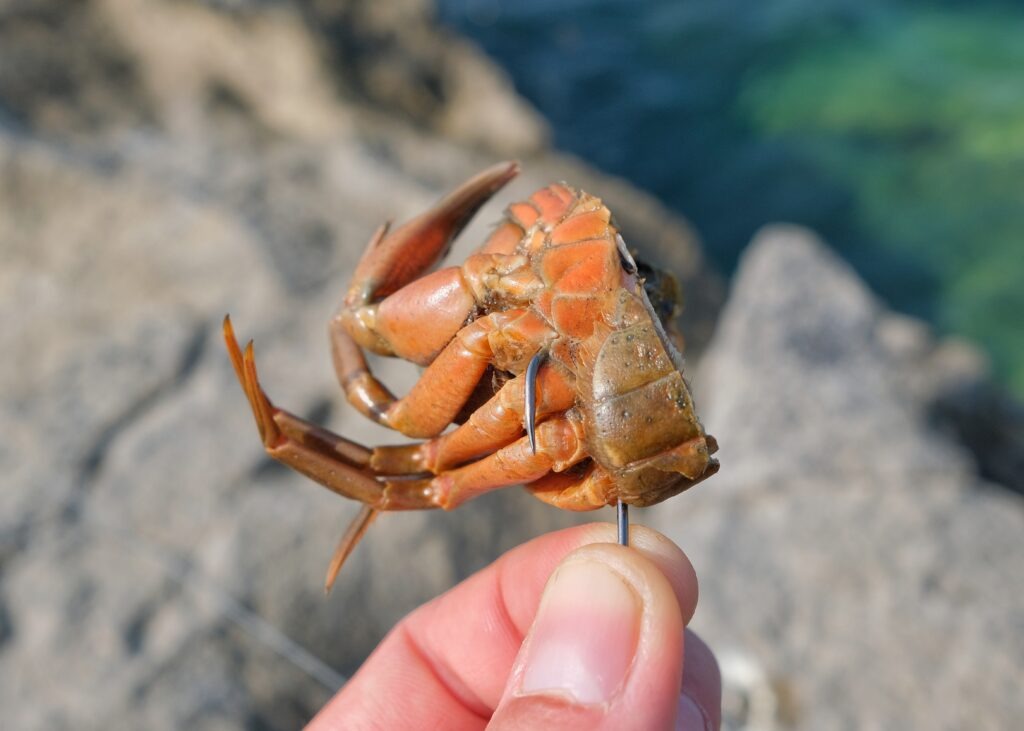
- Hardback crab is preferred to soft crab, as wrasse love it and it does away with the need to worry about using bait elastic
- A crab about the size of a fifty pence piece is perfect, but bigger crabs (green shore crabs, specifically) can be halved
- I dispatch crabs before using them (either in the freezer, or punctured through the underside) and don’t find them any less effective for it
- Once dispatched, I’ll hook a crab through a rear leg socket and come out a different leg socket, with the hookpoint just exposed
Terminal Tackle
Hooks:
- I’m a big fan of a Chinu pattern from e.g. Mustad or Cox & Rawle as they’ve a nice thick wire and don’t readily bend out – I’ve never had it happen
- Hooks in sizes 1-2/0 are the ones, with 1/0 a decent starting point
- I’ll always pre-crush the barbs with a set of pliers for easier unhooking
Rigs:
You’ve three main bait fishing options, here:
- Simple running ledger rigs, tied with strong but minimal components
- Float fishing rigs; tied with a stop knot, a couple of beads, a drilled weight, and a snap-swivel below the float for easy looping on of fresh ‘hooklengths’
- Scratching rigs of around 3-4ft in length, with a twisted boom section in the middle of them (or alternatively, a three way swivel)
Weights:
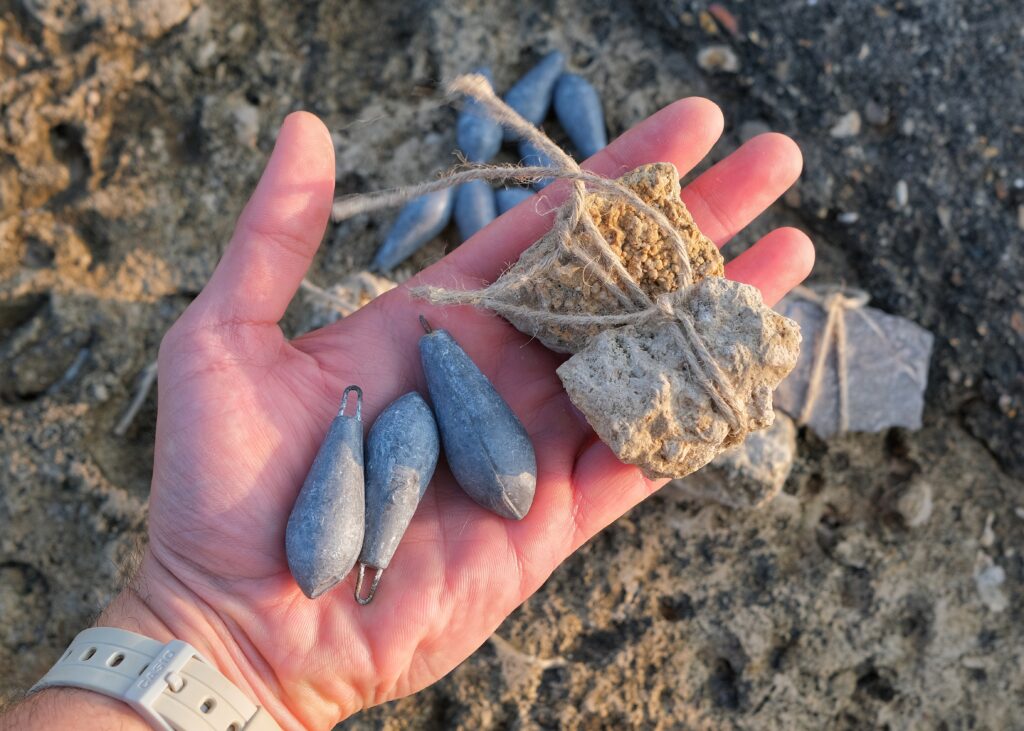
- For this style of fishing these will typically be 1-3oz
- You want to use the minimum needed to hold bottom, and this depends on amount of swell and state of the tide
- These days I favour using rocks as weights, tied on to the rig with hemp string. They look absolutely crackers, but you’ll lose less of them, they’re free, and (when lost) they’re much better for the environment
- Something like a paperclip also functions as a really effective rotten bottom – which is a simple way of dumping a snagged weight and not losing the entire hook link in the process
The Right Tackle
This particular bit of the guide has the potential to carry-on something silly, and it’s all been done to death anyway – nor is it something of particular interest to me! So I will keep it brief, as at its core this is all about whatever works for you. For me, that’s a 10-11ft travel rod (four sections) weighted for up to 110g. The rod is sensitive enough that I can comfortably feel bites through the tip, but has got enough clout to heft a 3oz lead to the horizon should I need it – which is a rare thing. It also fits in the boot of my car, year round.
Rod wise:
- Keep it 8-11ft in length. If you’re planning on holding the rod all day, you’ll want something lighter – but if you go too short, you’ll find yourself without enough power to control big fish at your feet
- A casting weight of 2-4oz (60-120g) is preferred, but ultimately this is a balance. You’ll need something with enough heft to get a big wrasse off the seabed, but also want enough gingerness in the tip to feel bites as they develop
Reel wise:
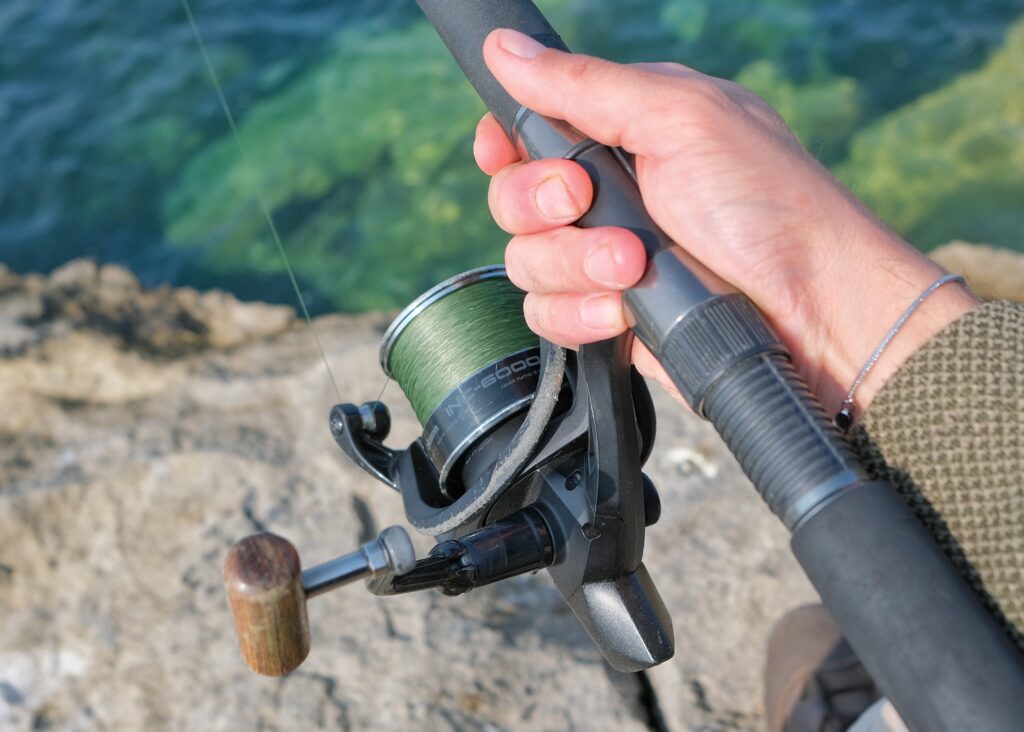
- 4000-6000 size is preferable, as is a fixed spool
- A strong drag with decent cranking power is key
- You could get away with something more dainty – and it’ll be fine for smaller wrasse – but when you hook/lose something bigger you’ll regret it (as I have done, several times)
Line wise:
- You’ll want a good strong braid (of 30lb plus) as mainline
- And a fluorocarbon hooklength of 20-30lb – regardless of whether you’re fishing a bottom bait or a float. These days, I ere towards the upper end and lose far less gear
The name of the game here is strength, abrasion resistance, and not leaving lengths of line all over the seabed. Yes, line strengths such as these are far more than your quarry actually weighs, but they are the only way you can give yourself a chance to actually pull these fish and your rigs out of their territory.
Bites and Hooking Fish
Wrasse bites are direct and to the point; the initial enquiry from a big wrasse can be delicate but the ‘take’ is always decisive… They’ll rarely ‘play’ with their food!
- Subtler bites will generally develop over 5-10 seconds; developing from a timid pluck to a full on rattle
- But the characteristic type of bite from a wrasse is a “TONK” – these are often out the blue, easy to miss, and get the adrenaline surging. The good news is they are generally followed by a quick pulling round of the tip
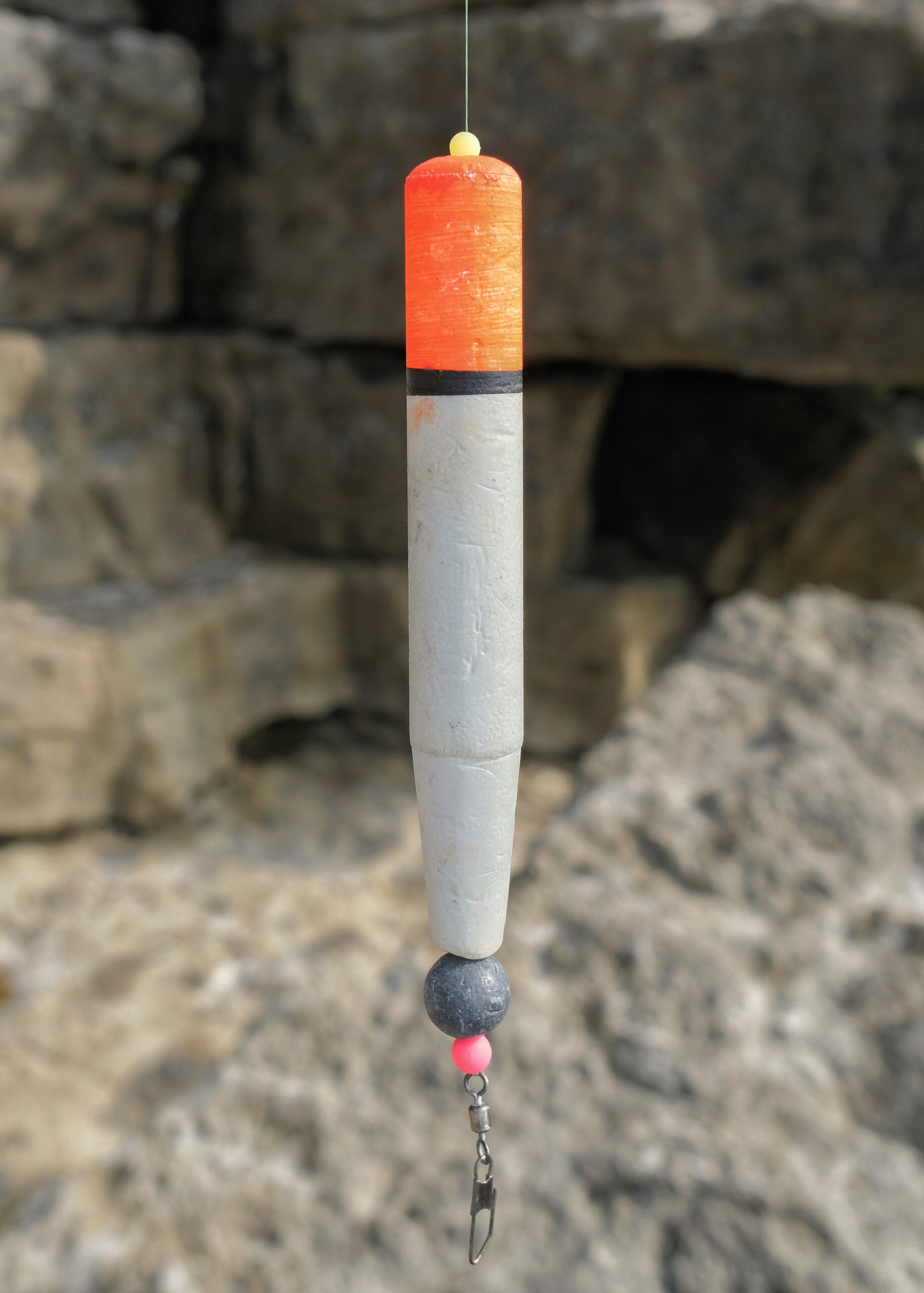
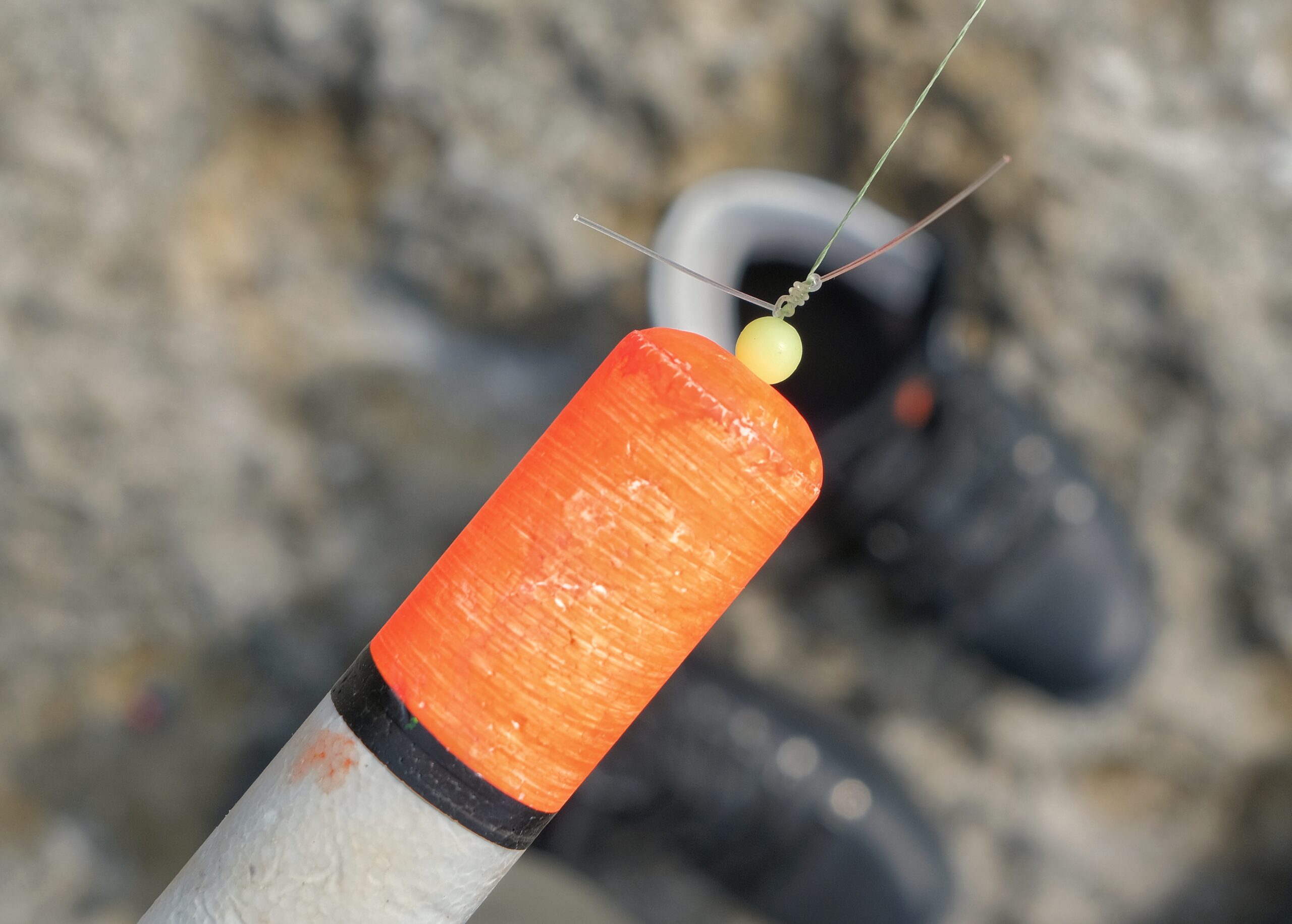
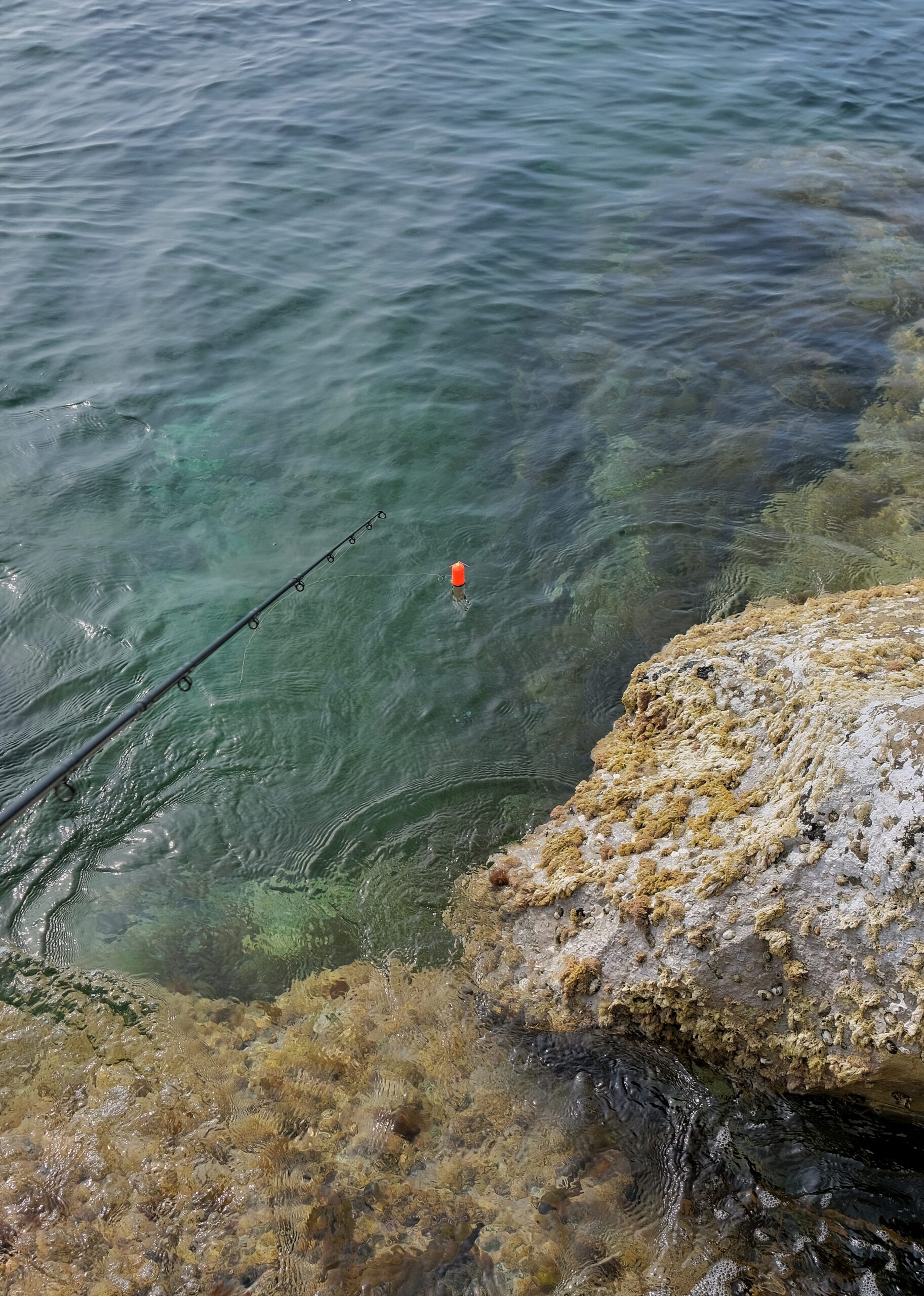
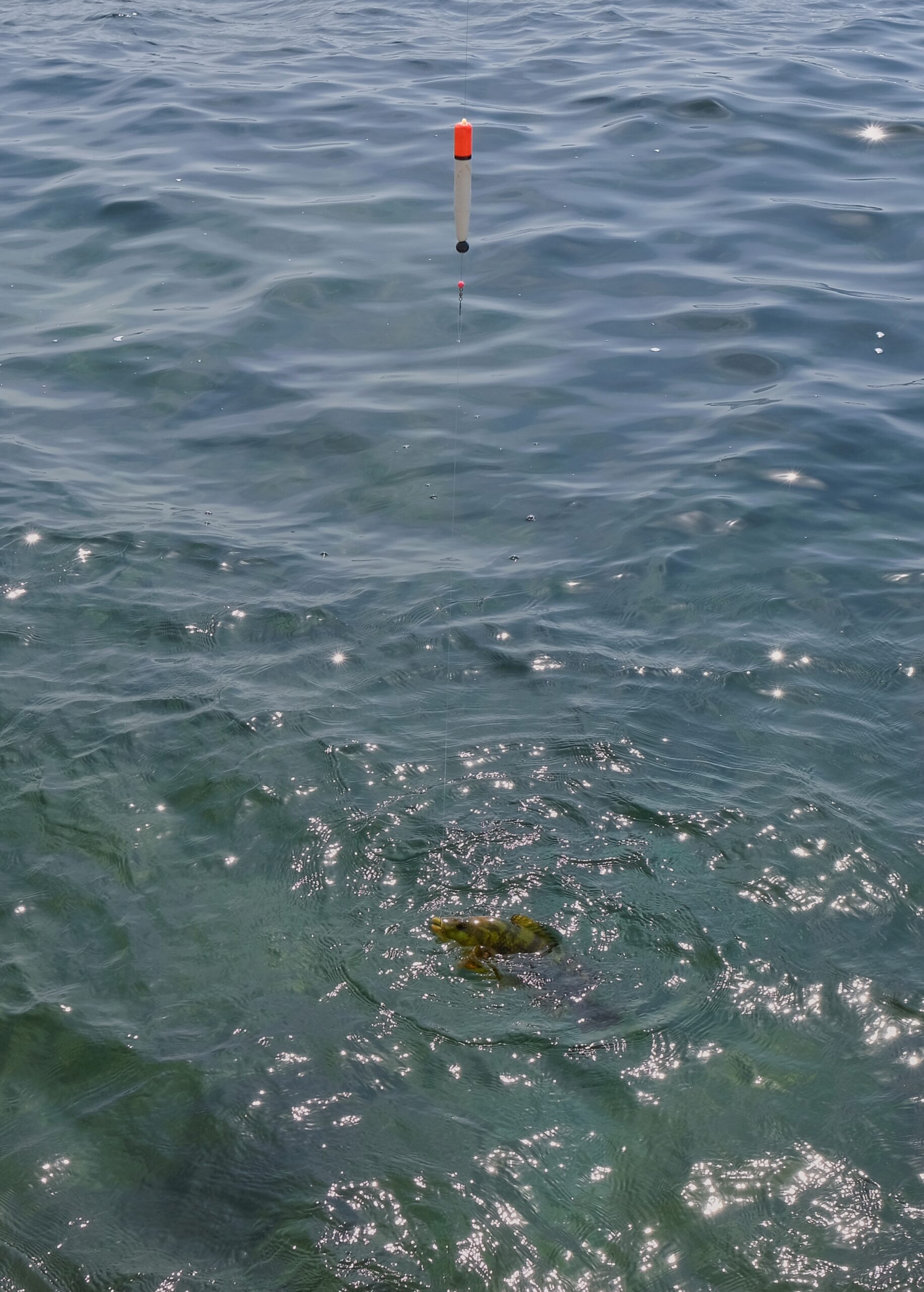
- If fishing a float, bites will generally always be quick sail aways, so keep your eyes on that float! If holding the rod, most of the time you’ll feel a bite developing through the braid before the float even dips. The big edge when float fishing is that if the strike is successful, it’s definitely easier to get wrasse up in the water when fishing a float, rather than with a heavy weight swinging below it
Strike all wrasse bites quickly, firmly, and apply pressure immediately. Unless the rod absolutely demands it, don’t give these rascals any ground.
Fishing Bait Effectively
Staying mobile when fishing is prattled about in all forms of angling – some clearly more seriously than others – but it really is key, here. For one, before even fishing, you’re likely going to be walking miles on the the coast path to find your spots, so you really don’t want to be encumbered by loads of clumsy gear.
- Get a decent rucksack which can hold your rod and net
- For comfort, make sure it has lumbar support and chest straps – and pack heavy items high up in the bag and close to your body. Nowadays, my backpack of choice is an ex-military issue Bergen
- When fishing, move between features, especially as the tide changes and new areas open up to you
- If all goes quiet in a spot, make a searching cast somewhere else or make a move further along the rocks
- In areas of either really rough ground (i.e. those which mercilessly eat tackle) or areas of fairly uniform/boulder fields – a float fished bait can be a real edge, and buy you bites when things go quiet!
- Focus on fishing different bits of structure and don’t get pot-committed to a particular area
- If you’ve caught a big fish, move on – as there’s unlikely to be another nearby!
Lure Fishing for Ballan Wrasse
Cast + Retrieve
Just like in bait fishing, after casting your lure you’re looking to let it settle on a semi-slack line to avoid it swinging back. I like to count it down, where possible, which can help when trying to get a feel for depth. Once it’s settled on the seabed:
- Use short lifts, moving the rod tip between a few inches to a foot each time – reel between lifts
- Let it fall between lifts, and don’t be afraid to pause regularly – as fish will often take a lure when static
The name of the game here is all about keeping the lure close to the structure at all times and, unsurprisingly, making sure that you fish it right to your feet.
The Right Lures
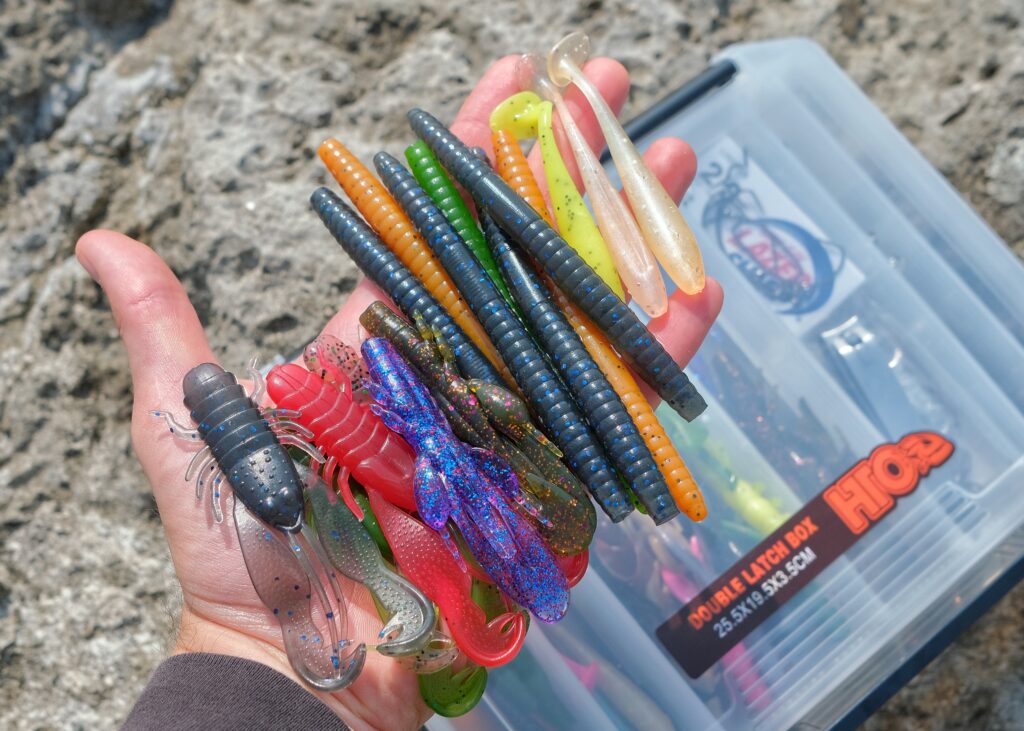
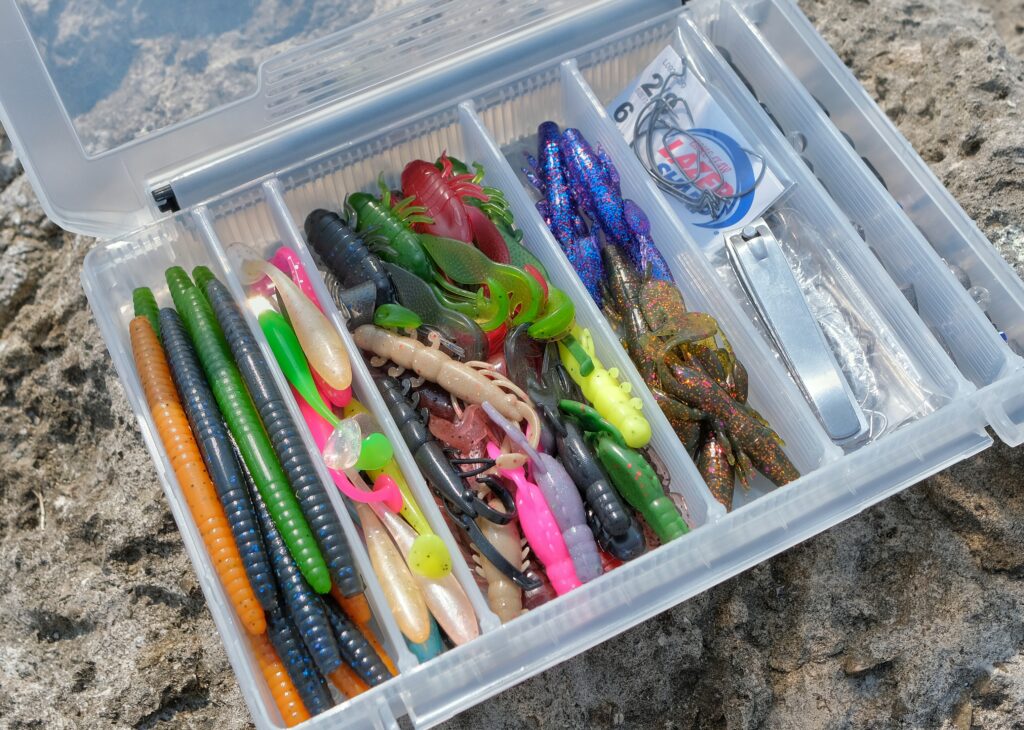
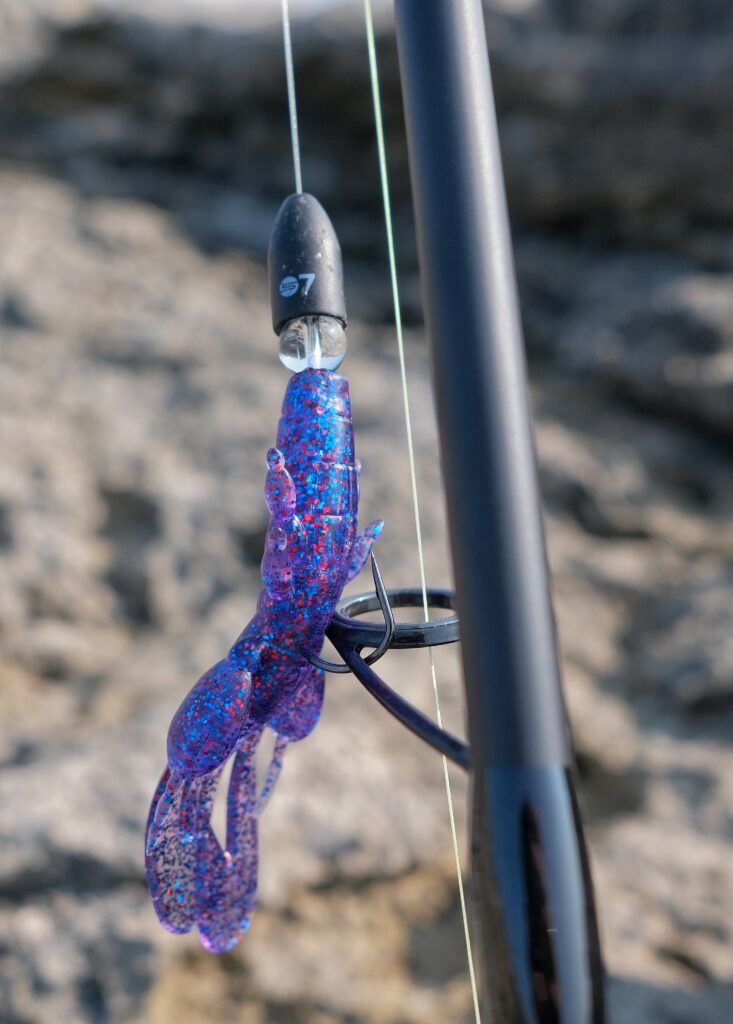
There’s really only two words needed here: soft plastics. In my tackle box, photographed, I’ll always carry a mixture of:
- Paddletails
- Stickbaits (senko-style worms)
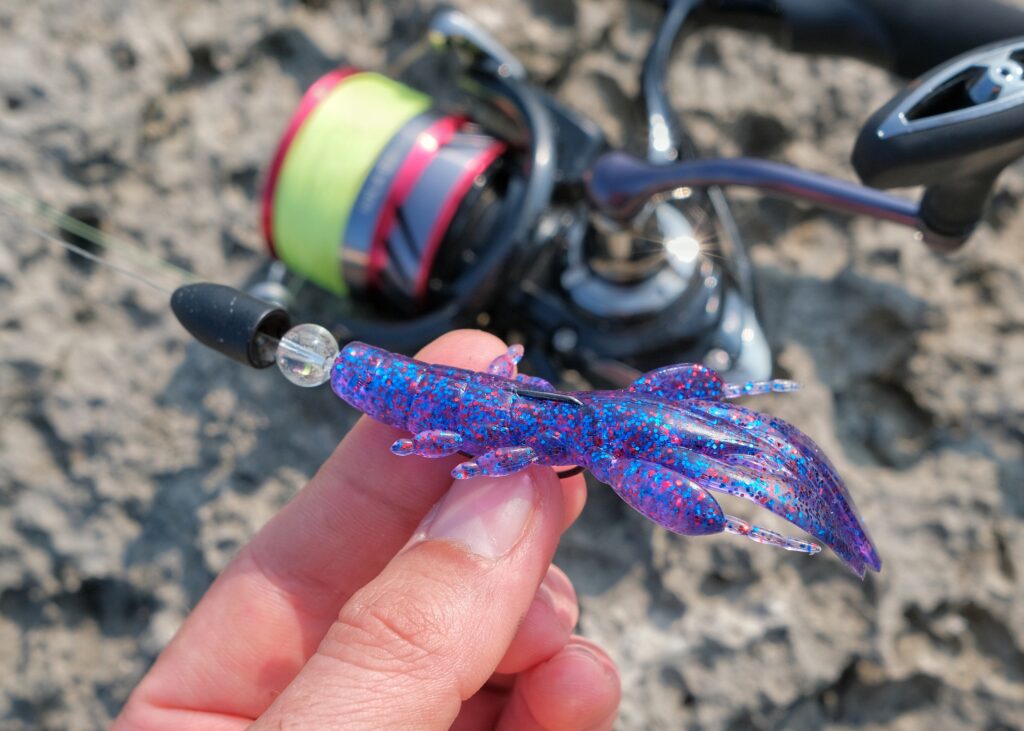
- And creature baits (craw or crayfish styles)
My personal favourite is a nice chunky creature bait, fished slowly. Of the three, I’ve fished with stick baits the least (at my peril) but some swear by them – especially for bigger ballan wrasse in the winter. However, all three styles will catch, and switching the style of lure for a couple of casts after working a piece of ground can and will often trigger unexpected bites.
I won’t be too prescriptive on a specific brand of lure here because (again!) it’s been done to death and there’s so much good stuff available to anglers these days. Z-man, Savage Gear, Westin, NIKKO, Fiiish… Keitech (Swing Impact, Crazy Flapper, Easy Shiner etc), Berkley… The list goes on, and they’ll all catch you fish. Being a working bloke, price and durability is often a big factor for me – and some of the offerings from ‘smaller’ companies and soft-plastic enthusiasts such as Coastal Lure Fishing, Rozemeijer, and Rooney’s Fishing Supplies etc. can all really fit the bill.
Likewise, a special shout out to the Big Lerf Tackle Shop and C.A.N Fishing Lures for really pushing the envelope on what’s available to the UK in terms of smaller and micro LRF style lures.
Lure Colour
This, again, is relatively simple.
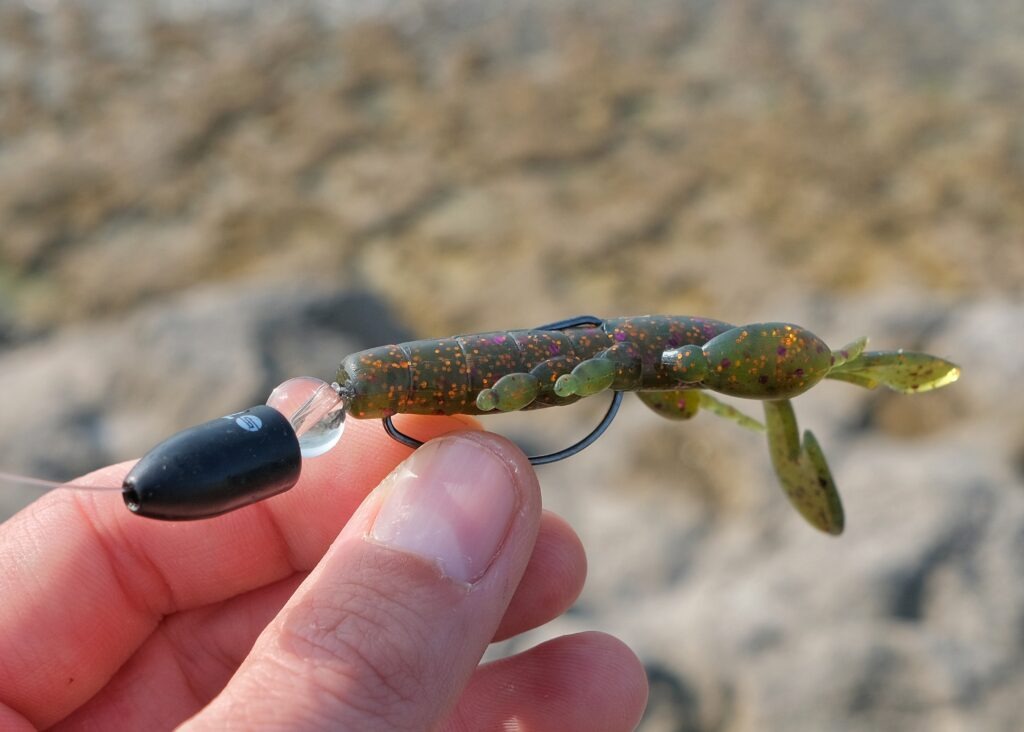
- In clearer water and bright sunshine, stick with dark and/or natural colours – little bits of subtle sparkle are always useful
- In coloured or murkier water, stick with brighter and/or high-contrast colours
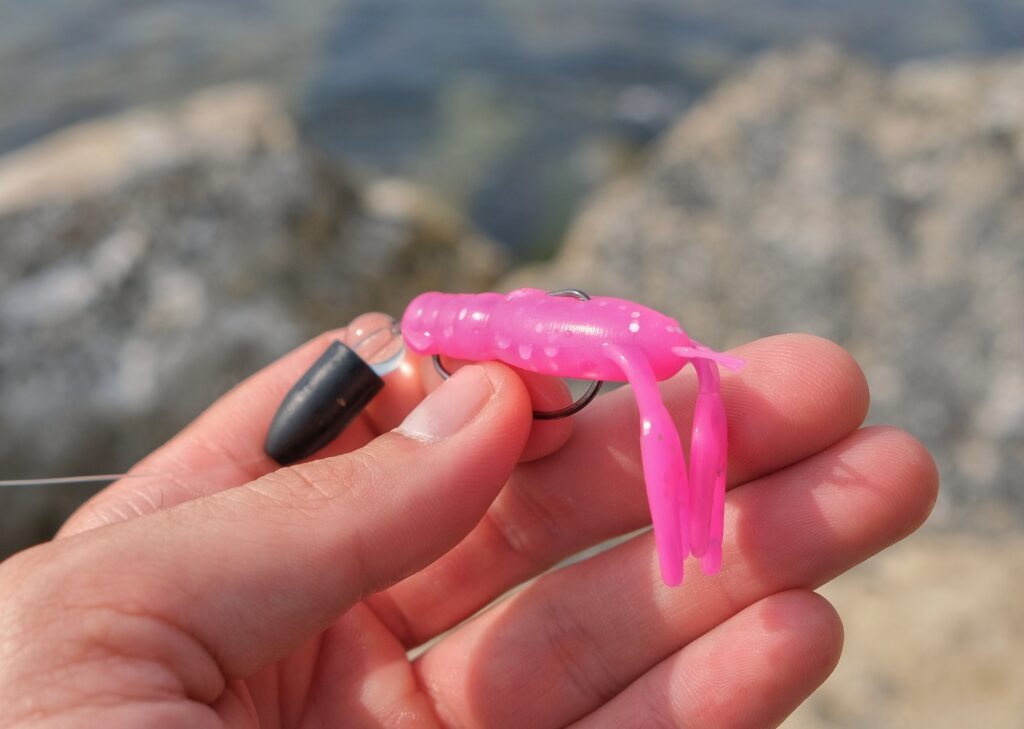
- Greens, deep reds and flashy purples are a good middle ground – I even have a couple of eye-watering hot pinks in my lure box, but have yet to catch on them!
Changing colour can sometimes be enough to trigger a bite. My initial casts will nearly always be with something drab like browns, blacks, or a khaki – and then if all’s quiet I’ll begin probing with reds, silvers, something chartreuse, or even those pinks/oranges.
Lure Types + How I Fish Them
Paddletails:
- Working a paddletail (i.e. a fish imitation) is very much about slow pulls and natural movement
- The beauty of the ‘paddled tails’ on these lures is that they impart plenty of movement and vibration unto the lure, so there’s no need for the angler to employ all the fancy flicking that you’d employ with a stick or creature bait
- It’s about letting the lure do its job, and riding against the tide from time to time. I will bounce a paddletail through a swim but it’s a much more deliberate movement and is interspersed with a steady retrieve
- It’s good to alter your retrieve style regularly – so mess around with a steady retrieve, and/or slower or faster retrieves
Stickbaits:
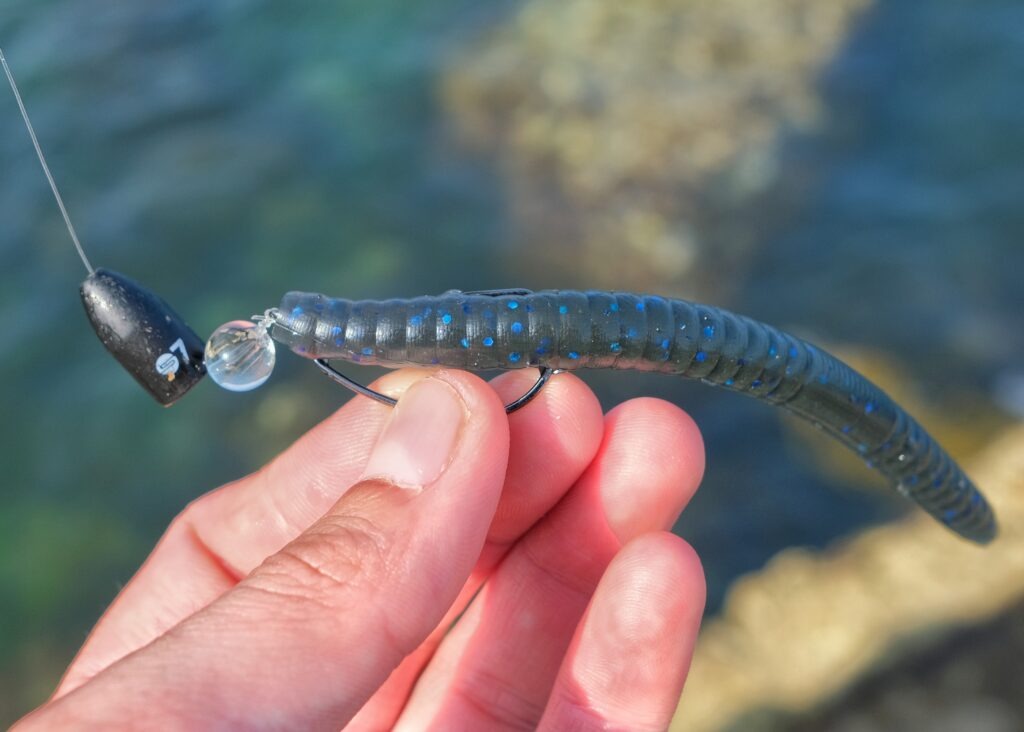
- For me, I’ve found fishing with stickbaits (e.g. senko style worms) to be something of a leap of faith, as they don’t really look like ‘anything’ – other than one strangely hopping worm!
- But when you do watch one, you can see why they work…
- Working a stick bait is a very similar to a creature bait, but it’s more about the short flicks and pauses
- You’re of course looking to work it on the bottom – anything around a couple of inches to a few feet – but you can flick/hop it around the swim a little more haphazardly than you would a proper creature bait
Creature baits:
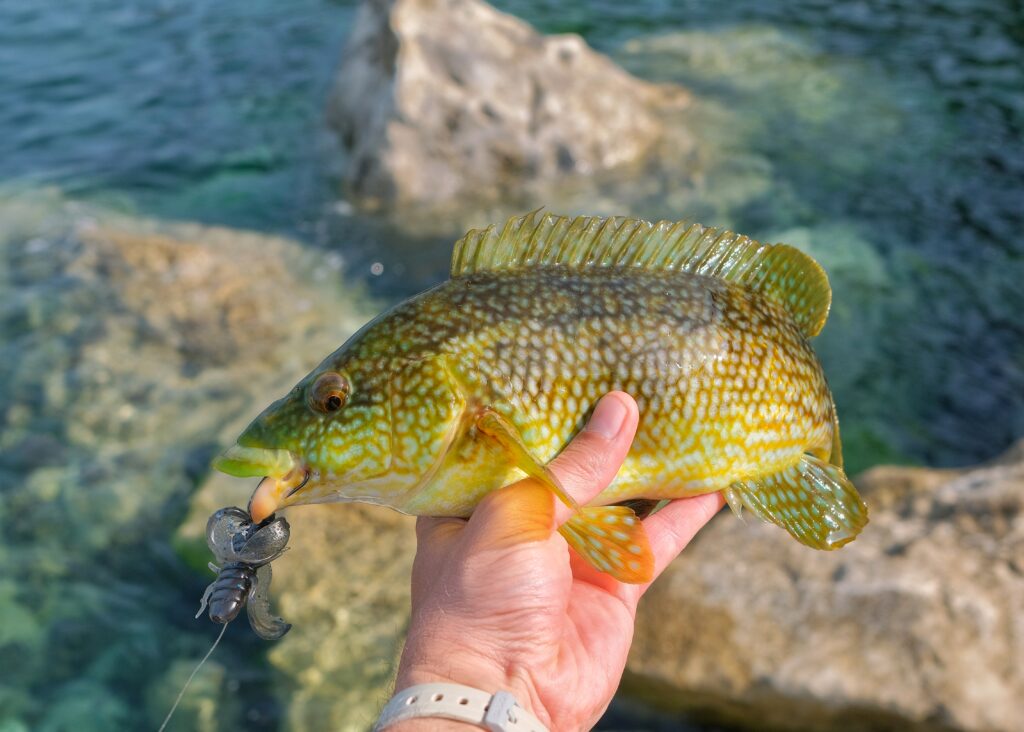
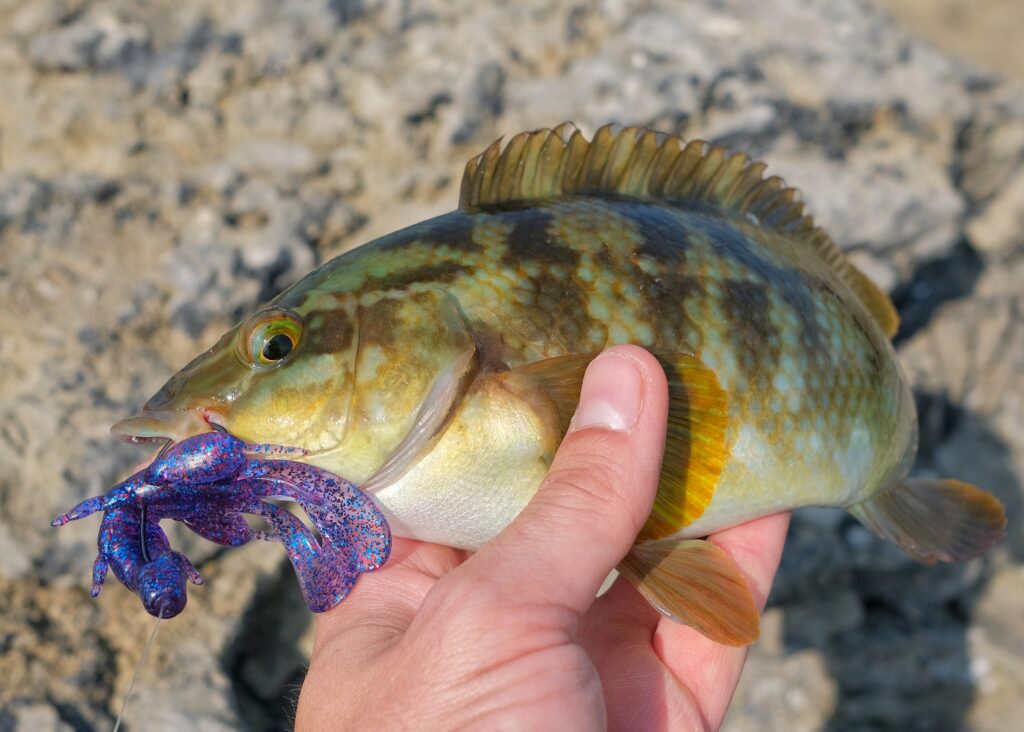
- Fishing a creature bait (effectively) is all about keeping in close contact with both the lure and the bottom
- You’re looking to imitate crustaceans, here. Small crabs, squat lobsters etc. Therefore, you’re looking to take your time with it, hopping the bait – delicately – across the rockwork
- I’ll lift a bait by a few inches every couple of seconds, and occasionally make a very deliberate pause – for anything up to 10 seconds – to see if anything makes a grab at it. Often, a take will come a few seconds into the pause; a subtle nibble then a pull round
Terminal Tackle
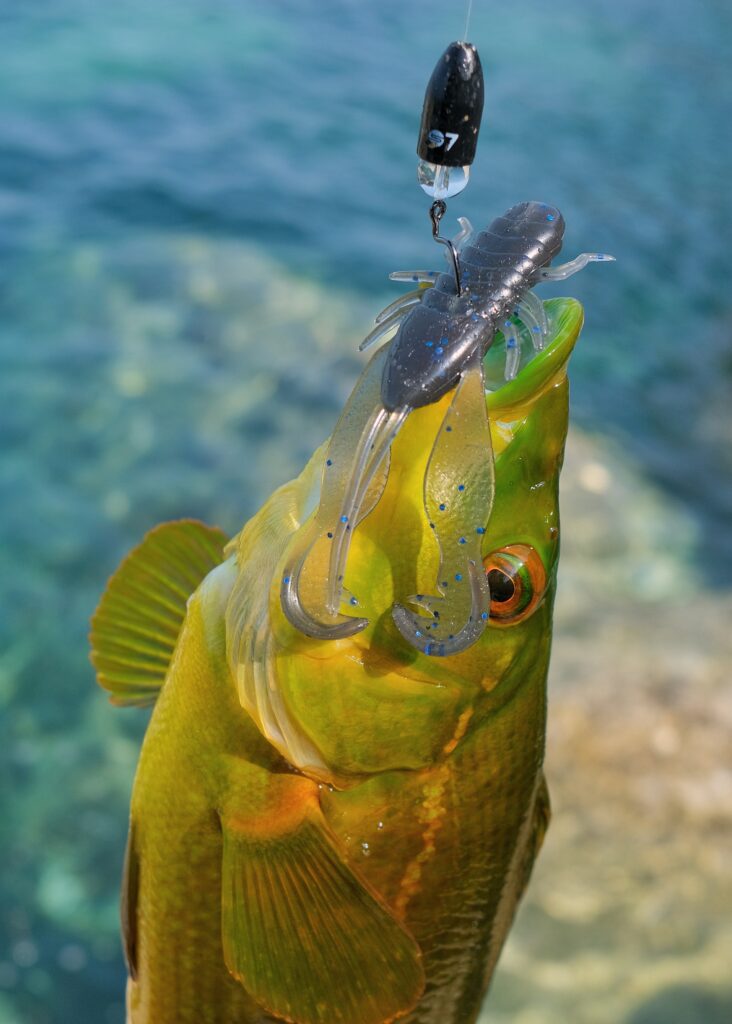
All of the below terminal tackle recommendations pertain to fishing with a texas rig, in weedless style. You could of course swap out the cone weights for e.g. cheb rigs in similar size (to allow for quick hook changes, and extra splashes of colour) but to keep things simple I’m “choosing Texas”.
You’re after:
- An abrasion resistant 25-30lb braid for mainline
- Approx. 3ft of 20lb fluorocarbon as leader
- 5, 7 and 10g cone weights
- Optional beads – in glass, brass or plastic
- Hooks in size 2 to 2/0
General Tackle
For hauling ballan wrasse on lure gear, you’re looking for something fast in action which gives a fine balance of heft, control, and sensitivity. For me, I’m a big fan of HTO and Daiwa travel rods – though you have brands like Westin who make fantastically priced and weighted/sized rods for this type of fishing:
- Ideally, you’ll want a 7-9ft fast rod with a fast action (I prefer a little longer, rather than shorter, for better playing of fish close in)
- You want something rated to cast around 7-35g, unless you’re going down more of an LRF route
- A 2500-3000-4000 sized reel will serve you well (again, I prefer a little larger – although heavier, it provides better cranking power)
Texas Rigging + Weedless Setup
Naturally, this final section on rigging could also be a whole other can of worms – but in the spirit of keeping things simple I won’t let it become one! Therefore, there will be no detailed info on Carolina, Drop Shot, Cheb, Neko and Jika rigs here… Likewise, Texas rigging and weedless hooking set ups are nothing new and there’s a plethora of information written on them, so I won’t flog the horse further. However, weedless Texas rigs are a versatile pairing which just feels perfect for targeting UK wrasse species in the rocky and weedy places they call home. So it’s a very sensible place for a novice to start. Sleek, tangle free, durable – light weight. Effective hook ups, and less snagged gear. What is there not to love?
- Approx. 3ft of 20lb fluorocarbon as leader, tied to the braided mainline with an FG Knot or an Albright Knot. Either of these knots will slip through your rod eyes very smoothly
- 5, 7 and 10g cone weights – either painted or plain, they’ll snuggle up nicely to a bead and can be changed out quickly. These can be made from lead, brass or tungsten – tungsten’s densest, and therefore best – but more expensive
- Beads. Regardless of whether you go clear, brass, glass or coloured, make sure they make that satisfying ‘clacking’ sound when they hit the weight. This sound no doubt travels well under water and catches the attention of curious wrasse
- Hooks in size 2 to 2/0. A 1/0 hook is generally my go to, and I prefer to go bigger so as to make sure there is a decent ‘gape’ to encourage better hook ups – match the hook size to the lure profile etc
- An offset hook, with a wide gape, a nice big eye and a thick shank – always remember to crush the barb
It’s a bit of an art to rigging weedless hooks, but once you’ve done it a few times you’re good for a lifetime. Essentially:
1) Nick the hook in the centre of the top end of the lure
2) Push the hook point around 5mm into the lure, coming out of the lure’s underside
3) Thread the lure down the hook, all the way to the bend near the eye
4) Rotate the lure around the shank, and line it up to how it will sit on the hook
5) Note where the hook needs to enter the bait, and proceed to pierce the underside of the bait in this spot
6) Thread the hook through the lure body and out the topside, following the curve of the bend in the hook as you do so. Straighten everything up, and;
7) Importantly, pull the body of the soft plastic just in front of the hook point – so that the hook point softly nicks the very outside of the bait, therefore becoming weedless
Fishy Conclusions
UK ballan wrasse fishing is, at its core, a beautifully simple thing. The rigs are effective and uncluttered, and the fish are obliging. You just need to find them! Find some rough ground, fish it well, and hang on for dear life if you hook a big one…
Like most types of fishing, the devil is slightly in the detail; less so from a tackle perspective, but more so in terms of understanding the tides and learning a mark. It can make a huge difference to your chances. Whether you lean towards bait, or lures, or a bit of both (like me) the fundamentals stay the same… Fish tight to structure, keep mobile, and pay attention to the water. Above all else, enjoy it – other than e.g. bass fishing, or delicate LRF work, I don’t think there are many other types of shore fishing in the UK that are this raw, active, intense, or just plain good fun.
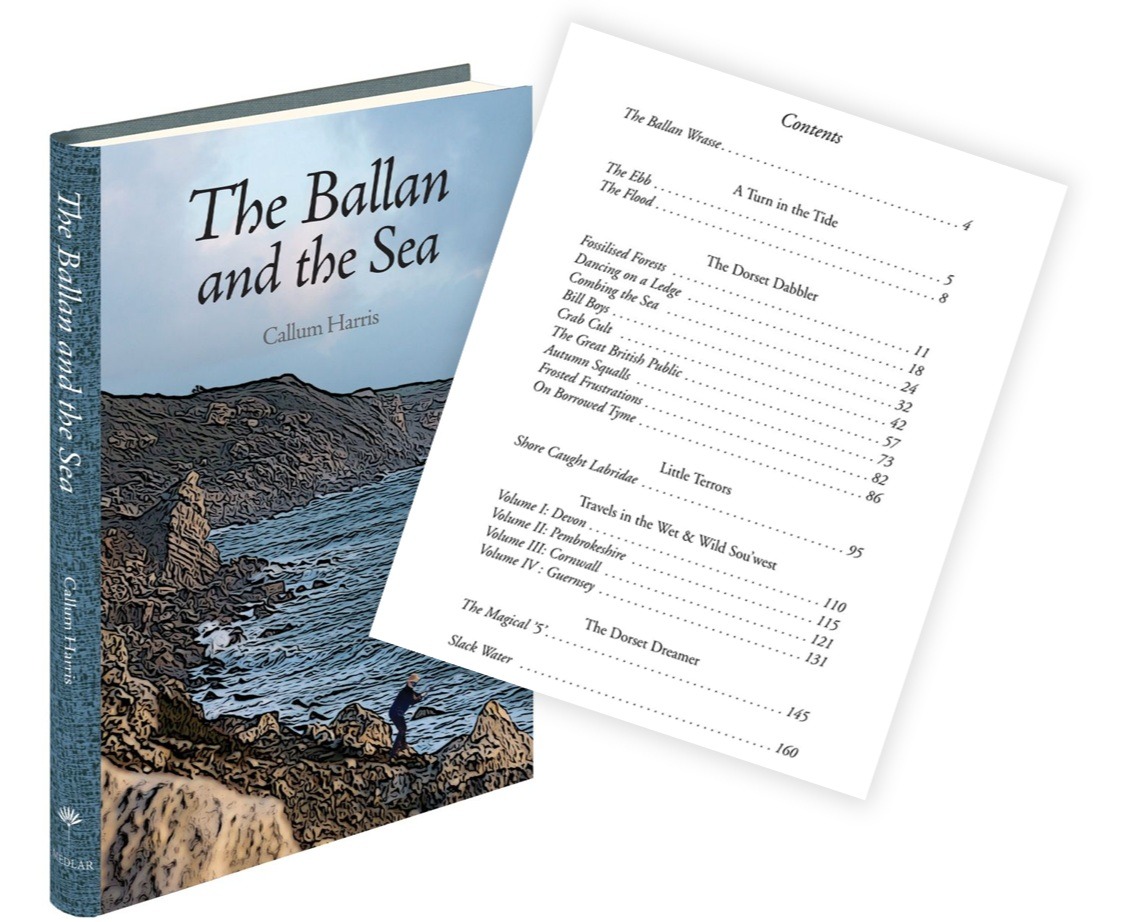
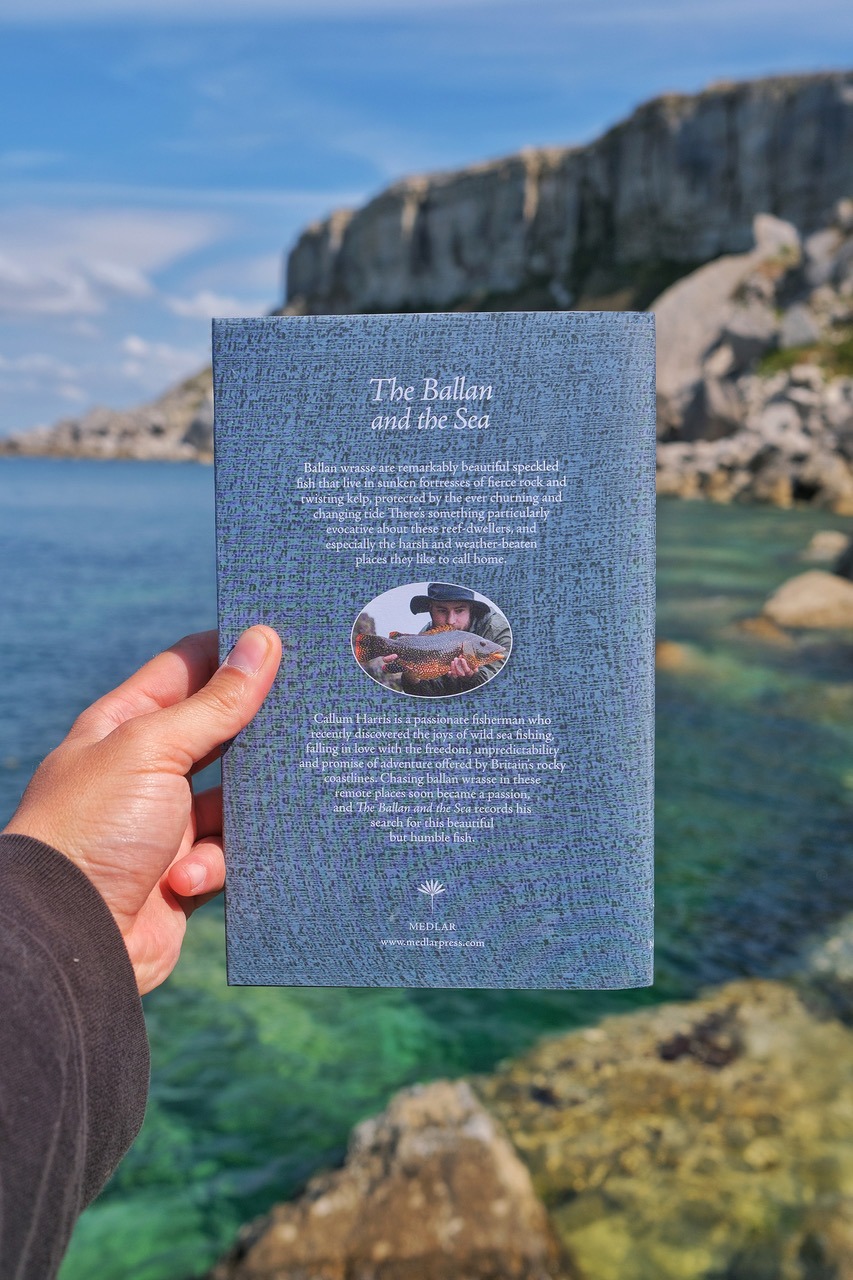
If you enjoyed this “how to” then please do drop me a comment to let me know. Or likewise, if you thought it was complete and utter rubbish, and terribly dry – do check out my book, published by Medlar Press, which is very much not a how to.